Decoding Your Body: How the Ideal Allergy DNA Test Unlocks a Healthier You
Picture this: It is a beautiful Sunday afternoon. You are sitting at a picnic with your closest friends, enjoying the fresh air and a spread of delicious food. Everyone else is laughing and passing plates around, but you are distracted. Your eyes are starting to water, and you feel that familiar, heavy bloat setting in after just a few bites.
You start the mental checklist. Was it the dairy in the dip? The pollen from the oak tree? Or maybe it was the dust on the picnic blanket?


We have all been there. Trying to play detective with our own health is exhausting. You cut out gluten for a week, switch laundry detergents, or hide indoors during spring, yet the answer often remains elusive. It feels like you are fighting an invisible battle against your own body. But what if the instruction manual for winning that battle was already written inside you?
This is where understanding your genetic blueprint changes the game.[1][2]
The Hidden Script in Your Cells
We often think of allergies or sensitivities as random bad luck, but there is often a deeper story written in our DNA. Your genes act as the primary code for how your body interacts with the world. They dictate how your immune system recognizes “invaders” like pollen, pet dander, or specific proteins in food.
The Ideal Allergy DNA Test does not just look at what you ate for lunch today. It looks at the genetic variations that you have carried since birth. These variations can indicate a higher predisposition (or risk) for developing sensitivities to specific triggers.[2]
By looking at the “source code,” you stop treating just the symptom and start understanding the root susceptibility. It helps support a shift from reactive quick fixes to proactive, long-term wellness.[3]
Why “Trial and Error” is Old School
For years, the standard approach to mysterious symptoms has been the elimination diet. You might spend weeks eating nothing but rice and boiled chicken, slowly reintroducing foods one by one. It is tedious, socially isolating, and often inconclusive.
Genetic testing offers a shortcut through that confusion. While it does not replace a doctor’s diagnosis of a current allergic reaction (like an anaphylactic response to peanuts), it provides a map of your potential risks.
Think of it like a weather forecast. A DNA test might tell you that you are genetically prone to “storms” when you consume dairy or encounter dust mites. Knowing this forecast allows you to bring an umbrella before it starts raining, rather than waiting until you are already soaked.
A Simple Sample, A World of Insight
If you are worried that “DNA testing” involves scary needles or clinical waiting rooms, you can breathe a sigh of relief. The experience is designed for the modern, busy individual.
The process with Camtech Health is refreshingly simple. You order the kit, it arrives at your door, and you provide a simple saliva sample.[4] No blood, no pain, and no taking time off work.
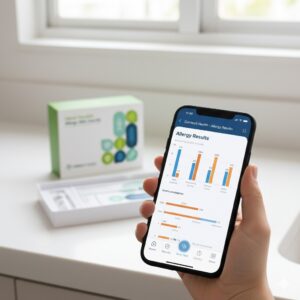
Once you return your sample, the real magic happens. In a few weeks, you receive a comprehensive report directly on the Camtech Health App.[4]This isn’t a dense medical file that requires a PhD to decipher. It is a user-friendly guide that breaks down your risk factors for food, plant, airborne, and chemical allergens in clear, accessible language.

Living in Sync with Your Genetics[2]
The true power of the Ideal Allergy DNA Test lies in what you do with the information. When you remove the guesswork, you can curate a lifestyle that supports your unique biology.
For the Foodie: If your results suggest a sensitivity to histamine, you can confidently choose fresh foods over aged cheeses or cured meats during your next dinner party.
For the Global Traveler: If you know you have a genetic risk for dust mite allergies, you might prioritize booking hotels with hypoallergenic bedding or hardwood floors.
For the Fitness Enthusiast: Understanding your predispositions can help you choose the right supplements or recovery snacks that won’t leave you feeling sluggish.
It helps support a life where you are in control. Instead of fearing your environment, you learn how to navigate it intelligently.
Your Wellness Journey Starts with Knowledge
There is a profound sense of relief that comes from understanding why your body reacts the way it does. It validates your experiences. It confirms that you weren’t “just imagining it” when that specific laundry detergent made you itch.
Taking the Ideal Allergy DNA Test is more than just a health check.[1][5][6] It is an act of self-care. It helps promote a deeper connection with your body, allowing you to make choices that fuel your energy rather than drain it.
Stop guessing and start knowing. Your genes have a story to tell, and it is time to listen.

FAQ: Understanding Genetic Allergy Testing
- Can the Ideal Allergy DNA Test diagnose a peanut allergy?
No. DNA testing identifies genetic predispositions and risks. A diagnosis of an acute, active allergy must be performed by a healthcare professional using clinical methods like IgE blood tests or skin prick tests. - How accurate is at-home DNA testing for sensitivities?
At-home kits use the same high-standard DNA sequencing technology found in clinical laboratories. The accuracy pertains to the identification of specific genetic markers (SNPs) which have been linked to sensitivities in peer-reviewed scientific studies. - Will my genetic risks change over time?
Your DNA remains constant throughout your life. While your actual allergic reactions may change due to age, environment, or gut health, the genetic “blueprint” identified by Camtech Health stays the same. - What categories of triggers are covered in the report?
The report typically covers a wide spectrum of potential triggers, including common food groups (dairy, gluten, histamine), environmental factors (pollen, dust mites, pet dander), and certain chemical sensitivities.
Disclaimer: These statements have not been evaluated by the Food and Drug Administration or local health authorities. This product is not intended to diagnose, treat, cure, or prevent any disease or medical condition.
*Visuals assisted by AI.
References: