
Colorectal Cancer Screening in Singapore: Why Younger Adults Should Pay Attention to Risk and Symptoms
By Stuart Chan

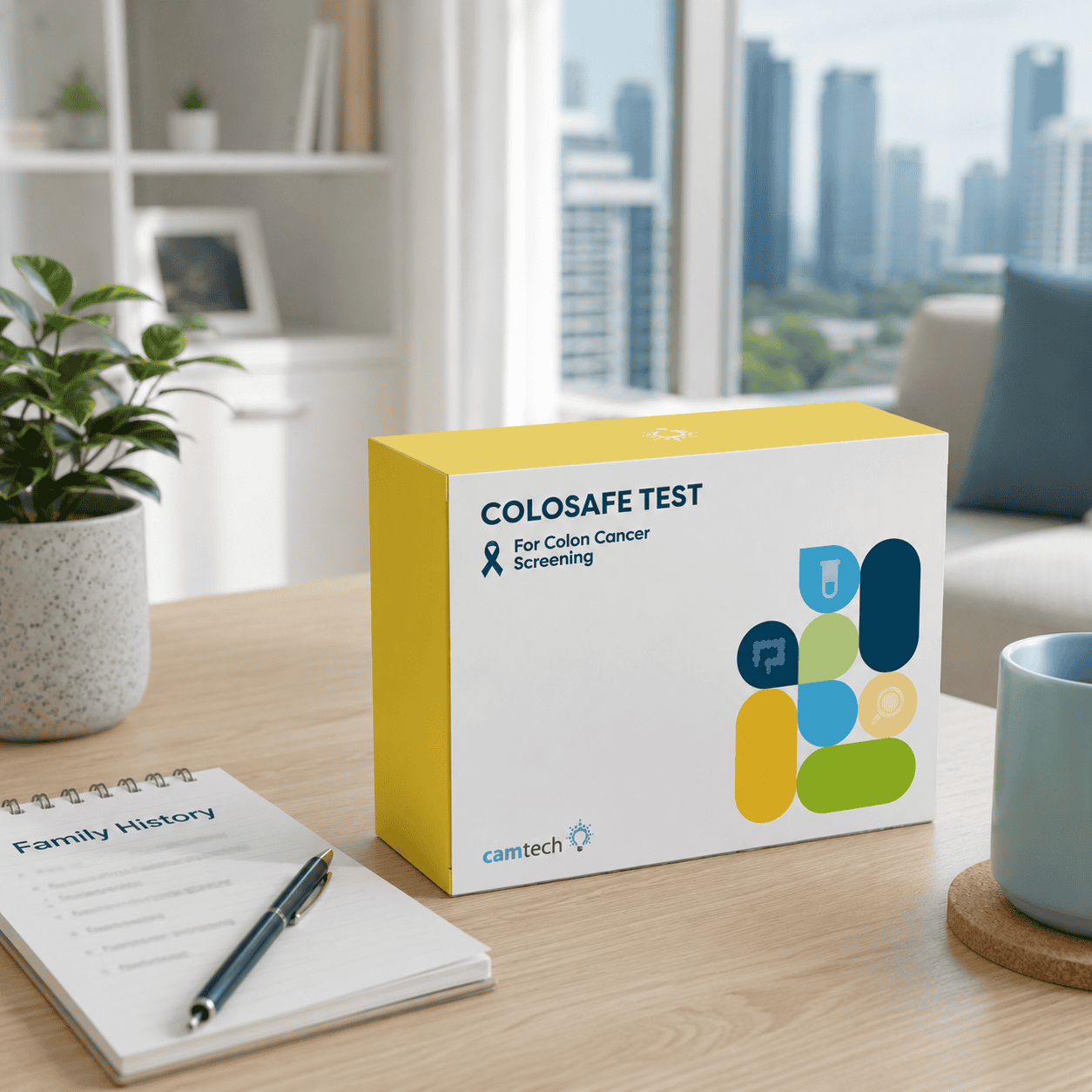
Colorectal cancer screening in Singapore is often discussed in relation to adults aged 50 and above. This remains important because national guidance for average-risk adults generally starts from age 50. However, younger adults should not assume bowel symptoms are always due to stress, diet, haemorrhoids or a temporary stomach issue.
Local reporting from the National Cancer Centre Singapore has highlighted a shifting pattern of early-onset colorectal cancer among adults under 50. This does not mean every younger adult needs the same screening pathway. It means symptoms, family history and personal risk factors should be discussed with a doctor earlier rather than ignored.
The changing picture of colorectal cancer in younger adults
In Singapore, HealthHub states that average-risk individuals should begin colorectal cancer screening at age 50, with FIT performed annually. Singapore Cancer Society similarly notes that men and women aged 50 and above are recommended to do FIT once a year or colonoscopy once every 5 to 10 years.
For younger adults, the conversation is more individualised. A person under 50 with persistent bowel symptoms, a first-degree family history of colorectal cancer, inflammatory bowel disease or previous colon polyps should discuss whether earlier assessment is clinically appropriate.
This is where proactive health screening Singapore conversations should be careful and balanced. Screening can support earlier clinical review, but it should not replace medical consultation, especially when symptoms are present.
Why national screening guidelines still matter
National screening recommendations are designed for population-level benefit. For average-risk adults with no symptoms, FIT remains a common first-line screening method from age 50. Under Healthier SG, eligible Singapore residents can discuss screening with their enrolled family doctor or CHAS GP.
However, screening guidelines apply mainly to people without symptoms. If you have blood in stools, persistent bowel habit changes or abdominal discomfort, this becomes a clinical assessment rather than routine screening. Your doctor may recommend stool testing, blood tests, colonoscopy or specialist referral depending on your symptoms and risk profile.
Key point for younger adults
Being under 50 does not remove the need to seek medical advice if bowel symptoms persist, recur or appear together with other risk factors. The right next step depends on your symptoms, family history and doctor’s assessment.
Symptoms younger adults should discuss with a doctor
Colorectal cancer may not cause symptoms in its early stages. When symptoms appear, they can overlap with many non-cancer conditions, including haemorrhoids, infection, inflammatory bowel disease or dietary changes. This is why persistent symptoms should be assessed rather than self-diagnosed.
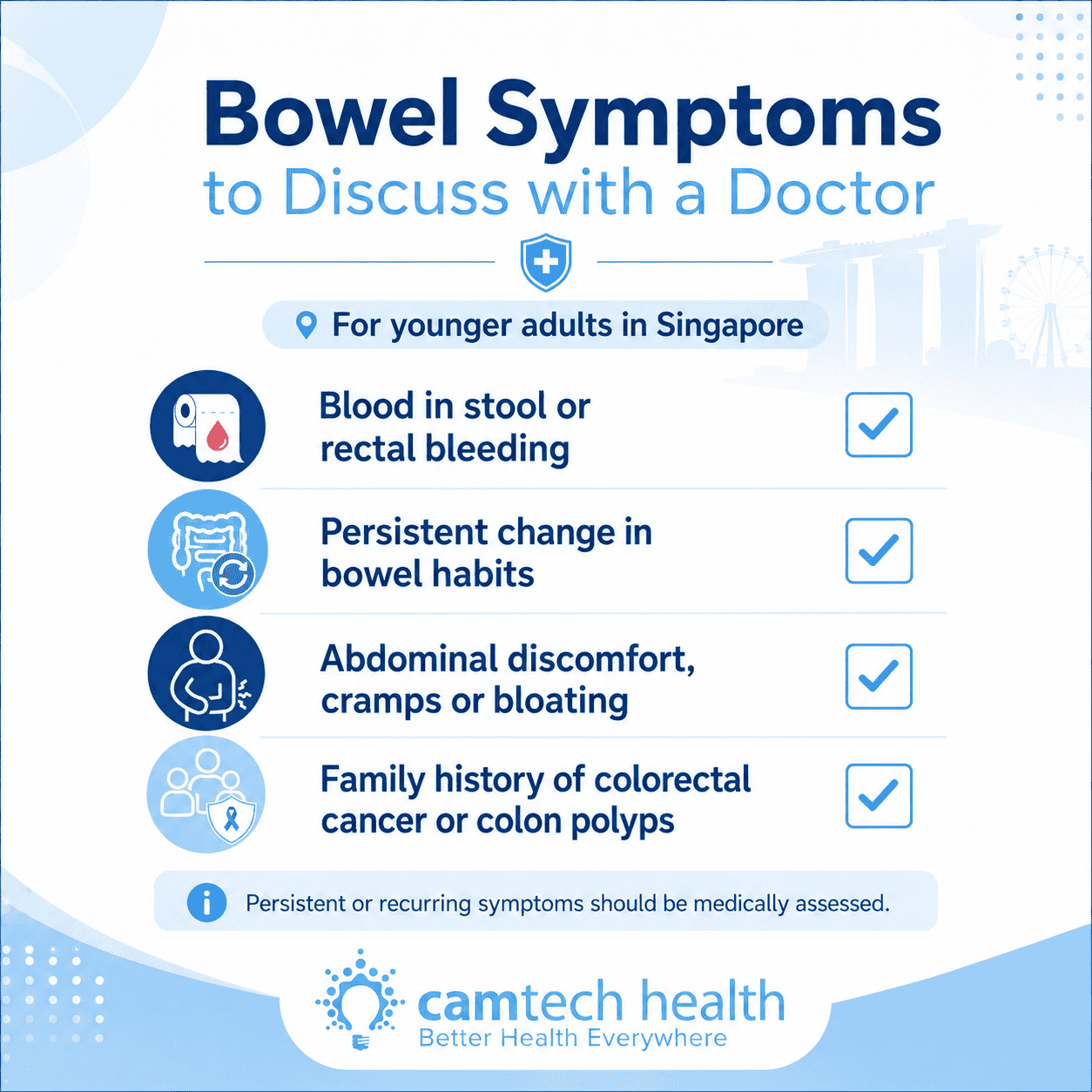
You should consider speaking with a GP or specialist if you notice:
- Blood in the stool or rectal bleeding
- A persistent change in bowel habits, such as diarrhoea or constipation
- Persistent abdominal discomfort, cramps, gas or bloating
- A sense that bowel emptying is incomplete
- Unexplained fatigue, appetite change or weight change
- A family history of colorectal cancer or advanced colon polyps
These symptoms do not automatically mean cancer. However, persistent or recurring symptoms deserve proper assessment, especially when they are new for you.
Family history and higher-risk situations
Family history is an important part of colorectal cancer risk assessment. HealthHub notes that people may have a higher chance of developing colorectal cancer if they have a family history of colon or rectum cancer, previous colon polyps, ulcerative colitis or Crohn’s disease.
Earlier or more frequent screening may be recommended for some individuals. This is especially relevant if a parent, sibling or child had colorectal cancer, if relatives were diagnosed at a younger age, or if there is a known hereditary cancer condition in the family.
If you are unsure about your family history, start by asking close relatives whether anyone has had colorectal cancer, colon polyps or repeated colonoscopy follow-up. Bring this information to your GP, polyclinic doctor or specialist so your screening plan can be based on your risk rather than age alone.
Where stool DNA testing fits in
Stool DNA testing is a form of non-invasive colon screening. Instead of looking only for hidden blood, a stool DNA test analyses stool for selected DNA markers associated with colorectal cancer or related changes.
The Camtech Health Colosafe Test is described as a stool DNA test used for colorectal cancer screening. According to Camtech Health, Colosafe looks for methylated SDC2 DNA, a biomarker found in stool, and allows sample collection at home. Results are stated to be available in 7 to 10 working days after returning the sample.
For adults exploring a stool DNA test Singapore option, Colosafe may be relevant as part of a broader screening discussion. It is a screening test, not a diagnosis. If a result is abnormal or if symptoms are present, a doctor may recommend further assessment, including colonoscopy where clinically appropriate.
FIT, stool DNA test and colonoscopy: how they differ
Different screening options answer different clinical questions. FIT detects small amounts of blood in stool. A stool DNA test looks for selected DNA markers in stool. Colonoscopy allows direct visual assessment of the colon and rectum and may allow removal of polyps during the same procedure when clinically appropriate.
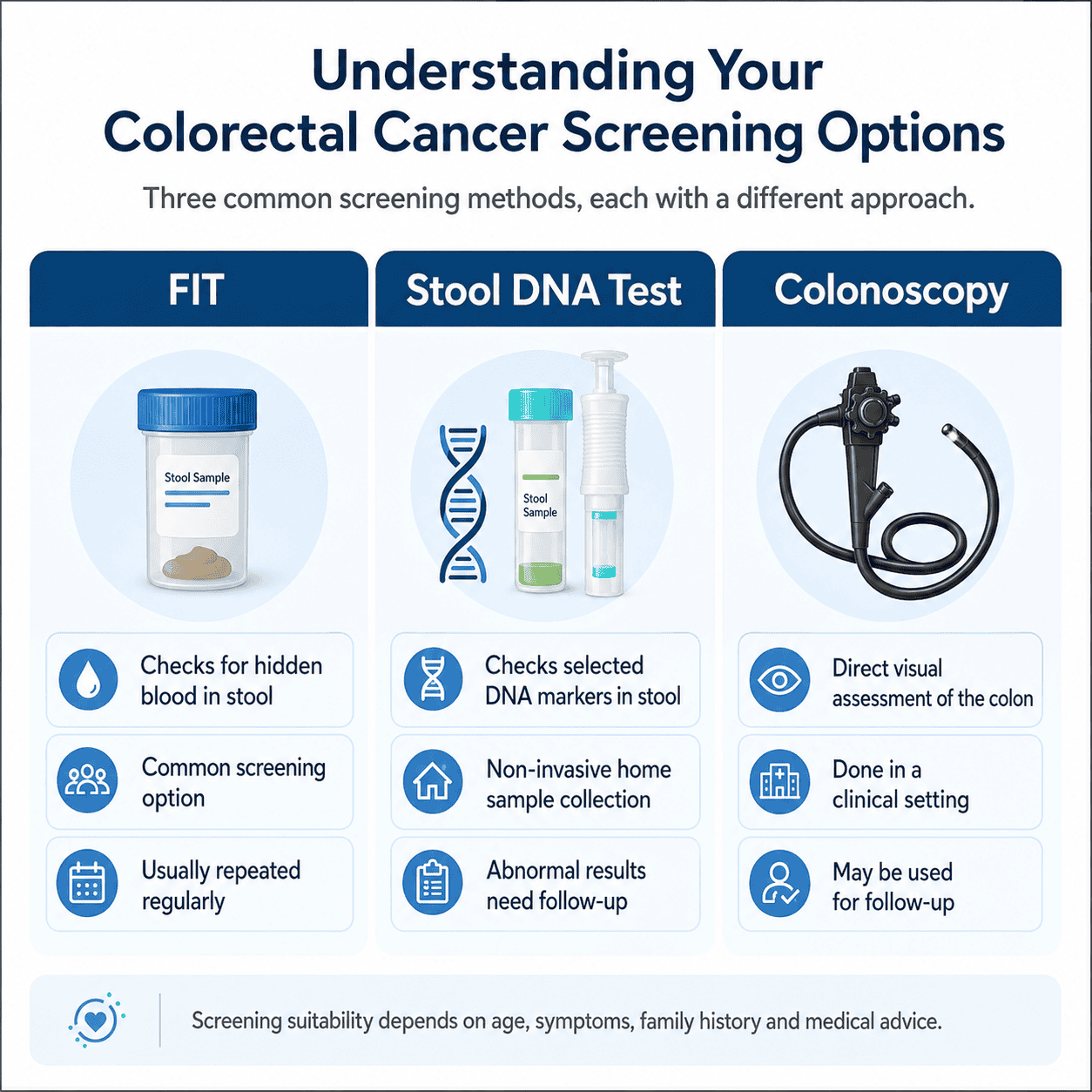
| Option | What it checks | How it is usually used | Important limitation |
|---|---|---|---|
| FIT | Hidden blood in stool | Common screening option for average-risk adults aged 50 and above in Singapore | A positive result needs follow-up assessment. A normal result does not replace medical review if symptoms are present. |
| Stool DNA test | Selected DNA markers in stool | Non-invasive colon screening option with home sample collection | It is a screening test, not a diagnosis. Abnormal results require clinical follow-up. |
| Colonoscopy | Direct visual assessment of the colon and rectum | May be recommended for symptoms, higher-risk individuals or follow-up after abnormal screening results | Requires clinical appointment, bowel preparation and medical assessment of suitability. |
If you are deciding between options, speak with a doctor about your age, symptoms, family history, medical history and personal preferences. You may also browse Camtech Health’s approved tests in Singapore to understand available testing options.
When younger adults may need earlier discussion
Younger adults may benefit from earlier discussion with a doctor if they have symptoms, a first-degree relative with colorectal cancer, a personal history of colon polyps, inflammatory bowel disease or a known inherited cancer syndrome in the family.
Earlier discussion does not always mean immediate colonoscopy. It means your doctor can assess whether routine monitoring, stool-based testing, specialist referral or colonoscopy is clinically appropriate. For some people, especially those with symptoms or higher-risk histories, a screening-only approach may not be enough.
Questions to bring to your doctor
- Do my symptoms need further investigation?
- Does my family history change the age I should start screening?
- Is stool-based screening suitable for me, or should I consider colonoscopy?
- If I do a stool DNA test, what follow-up is needed for an abnormal result?
How to make screening easier to act on
Many people delay colorectal screening because bowel health can feel private, inconvenient or uncomfortable to discuss. A practical first step is to make the process more organised. Keep a simple record of symptoms, family history and previous screening dates. This helps your doctor understand whether your situation is routine or needs closer review.
For those using Camtech Health tests, the Camtech Health App can help organise reports and health information in one digital space. Whichever pathway you choose, the key is follow-through. Stool-based screening is only useful when samples are collected correctly, results are reviewed, and abnormal findings are followed up with a qualified doctor.
Considering non-invasive colorectal screening?
Camtech Health’s Colosafe Test is a stool DNA screening option designed for at-home sample collection. Suitability depends on your symptoms, age, family history and medical risk profile.
View the Colosafe TestReferences
- HealthHub Singapore. Colorectal Cancer: Understand the Risk Factors, Symptoms and Different Screening Methods.
- Singapore Cancer Society. Colorectal Cancer Screening and FIT Kit Singapore.
- National Cancer Centre Singapore. More younger adults diagnosed with early-onset colorectal cancer in Singapore.
- Chen HLR et al. Trends in Early-Onset Colorectal Cancer in Singapore: Epidemiological Study of a Multiethnic Population. JMIR Public Health and Surveillance. 2025;11:e62835.
Medical Disclaimer
This article is for general education only and does not replace consultation with a qualified doctor or healthcare professional. It should not be used to self-diagnose, delay care, or choose a screening pathway without clinical advice. If you have blood in stools, persistent bowel habit changes, abdominal pain, unexplained weight change, or a family history of colorectal cancer, please consult a doctor in Singapore for assessment.
*Visuals are assisted by AI
Patient FAQ
1. Should younger adults in Singapore screen for colorectal cancer before age 50?
Not every younger adult needs routine colorectal screening before age 50. However, you should speak with a doctor earlier if you have persistent bowel symptoms, rectal bleeding, a first-degree relative with colorectal cancer, inflammatory bowel disease, previous colon polyps or a known inherited cancer condition in the family.
2. What colorectal cancer symptoms should younger adults look out for?
Symptoms that should be discussed with a doctor include blood in stools, rectal bleeding, persistent diarrhoea or constipation, ongoing abdominal discomfort, a sense of incomplete bowel emptying, or unexplained fatigue and weight change. These symptoms can have many causes, but persistent symptoms should be assessed.
3. Is a stool DNA test the same as a FIT test?
No. FIT checks for hidden blood in stool, while a stool DNA test checks for selected DNA markers in stool. Both are non-invasive stool-based options, but they work differently. Your doctor can advise which option is suitable based on your age, symptoms, risk profile and follow-up needs.
4. Does an abnormal stool DNA test mean I have colorectal cancer?
No. An abnormal stool DNA result does not confirm cancer. It means selected markers were detected and follow-up assessment is needed. Your doctor may recommend colonoscopy or other investigations. A normal result also does not replace medical care if symptoms are present.