Family History and DNA Testing: How to Use Both Together
By Stuart Chan
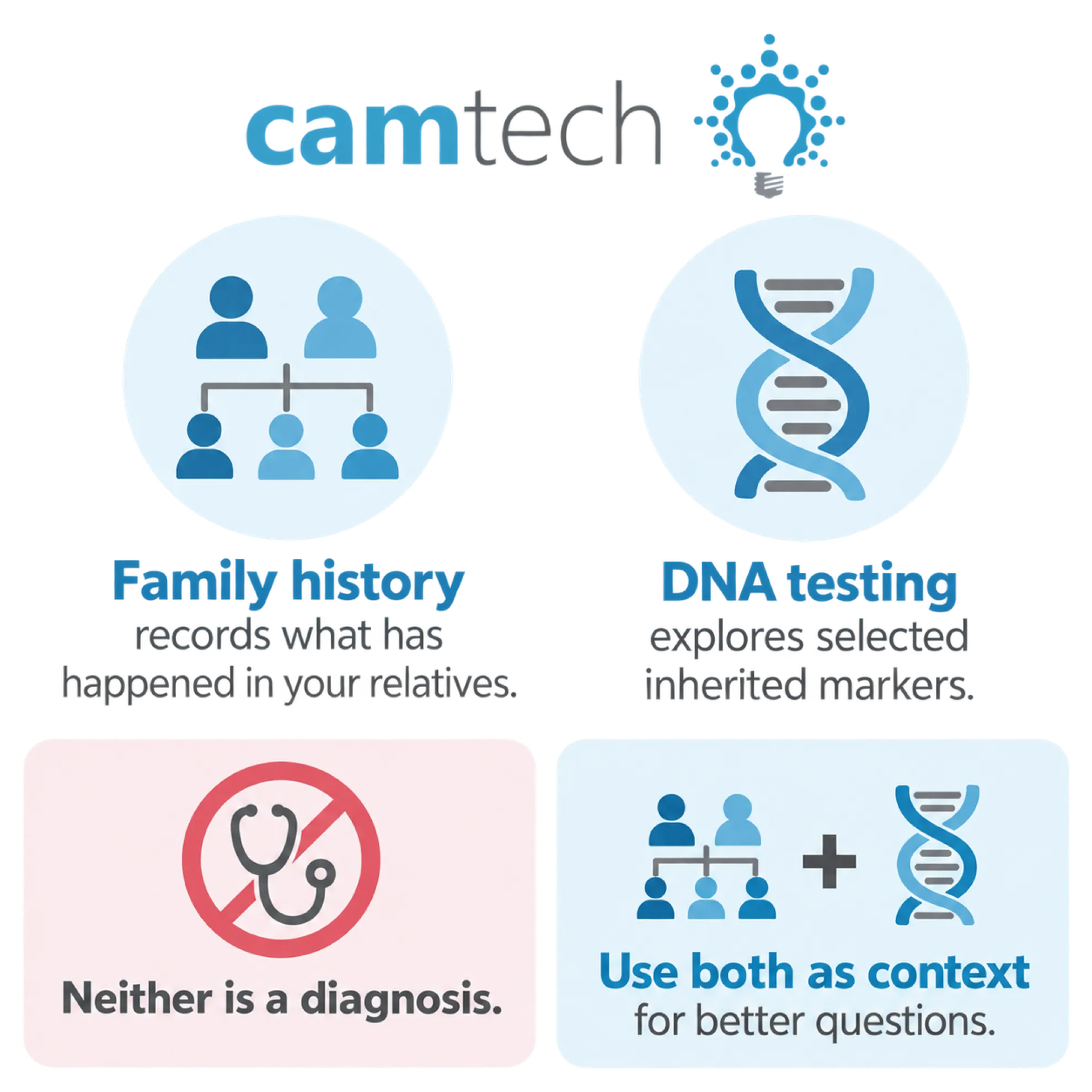
Your family health history and your DNA can both offer useful clues about health, but they answer different questions. Family history shows patterns of conditions across relatives who may share genes, environments and habits. DNA testing examines selected genetic variants or traits. Used together, they can support a more informed conversation with a qualified healthcare professional, but neither should be treated as a diagnosis on its own.
Two sources of information, not competing choices
The question is not usually whether family history or DNA testing is better. Each offers a different layer of information.
Family health history
- Records health patterns across relatives and generations.
- Reflects a mixture of shared genes, environments, behaviours and access to care.
- May help a clinician decide whether earlier screening or a specialist referral should be considered.
- Can be useful even when no genetic test has been taken.
DNA testing
- Examines specific genetic variants or traits included in a particular test.
- Focuses on genetic information and does not capture every environmental or lifestyle influence.
- May provide lifestyle-focused insights or, in a clinical setting, help answer a defined medical question.
- Needs to be interpreted according to the test's purpose, coverage and limitations.
The US Centers for Disease Control and Prevention explains that family history can help healthcare professionals consider screening and preventive steps. It also stresses that having a family history of a condition does not mean a person will definitely develop it.
What family history can tell you
A useful family history goes beyond listing conditions. It includes which relatives were affected, how closely they are related to you, their age when a condition began, and whether similar conditions appeared on the same side of the family.
Patterns can guide better questions
A pattern involving several close relatives, a condition occurring at an unusually young age, or multiple related conditions in one branch of a family may be worth discussing with a healthcare professional. Depending on the pattern and local guidance, that conversation may lead to tailored screening advice, genetic counselling or clinical genetic testing.
Family information is often incomplete
Not every family has complete medical records. Relatives may use different names for the same condition, may not know a formal diagnosis, or may prefer not to share details. Adoption, donor conception, estrangement and small family size can also limit the available picture. An incomplete history is still worth recording, as long as unknown details are marked as unknown rather than guessed.

What DNA testing can add
Genetic testing is not one single service. A clinical test ordered for a specific medical question is different from a direct-to-consumer or lifestyle-focused DNA test. The genes and variants examined, the evidence behind them, the laboratory process and the intended use can all differ.
The CDC's overview of genetic testing notes that results may be interpreted alongside family history, age and other factors. This context matters because a genetic result rarely tells the whole health story.
A result is limited to what the test examines
A negative result does not necessarily mean there is no inherited susceptibility. A test may examine only selected variants, while other relevant variants may not be included or may not yet be well understood. The US Food and Drug Administration advises people to continue routine preventive care and recommended screening even after a negative direct-to-consumer result.
Some results need professional confirmation
If a consumer test reports a potentially important health finding, avoid making treatment, screening or dietary decisions from that result alone. A qualified healthcare professional or genetic counsellor can review the test type, family history and personal health context, and can advise whether confirmatory clinical testing is appropriate.

Key points
- Family history captures patterns created by shared genetics, environments and behaviours.
- DNA testing examines only the genetic information included in that particular test.
- A positive result is not a diagnosis, and a negative result does not remove every possible risk.
- Routine screening and professional care should continue according to local guidance.
How to use family history and DNA information together
1. Build a practical family record
Start with parents, siblings, children and grandparents, then add aunts, uncles and cousins where information is available. Record the condition, approximate age at diagnosis and side of the family. Update the record when new information emerges.
2. Define what you want a DNA test to answer
Check whether a test is intended for lifestyle traits, ancestry, carrier status, a defined health risk or diagnosis. Review which genes or variants it covers, what type of sample it uses, how results are reported, and what professional support is available. Also review privacy, data storage, data-sharing and deletion terms before providing a sample.
3. Compare the information without forcing a match
A family pattern may exist even when a consumer DNA report shows no relevant finding. A DNA report may also describe a trait that has never appeared in known family history. Neither situation automatically proves that one source is wrong. Test coverage, incomplete family information, chance, lifestyle and environmental factors can all contribute to differences.
4. Bring the complete picture to a professional
Share the family record, the full laboratory or consumer report, the name of the test and its stated limitations. A professional can help distinguish lifestyle information from findings that may require clinical review. MedlinePlus Genetics notes that genetics professionals can explain the benefits, risks and limitations of a particular test.

Where an at-home lifestyle DNA test may fit
An at-home lifestyle DNA test can be one source of information about selected traits. It should not be confused with clinical testing designed to diagnose a condition or answer a specific inherited-disease question.
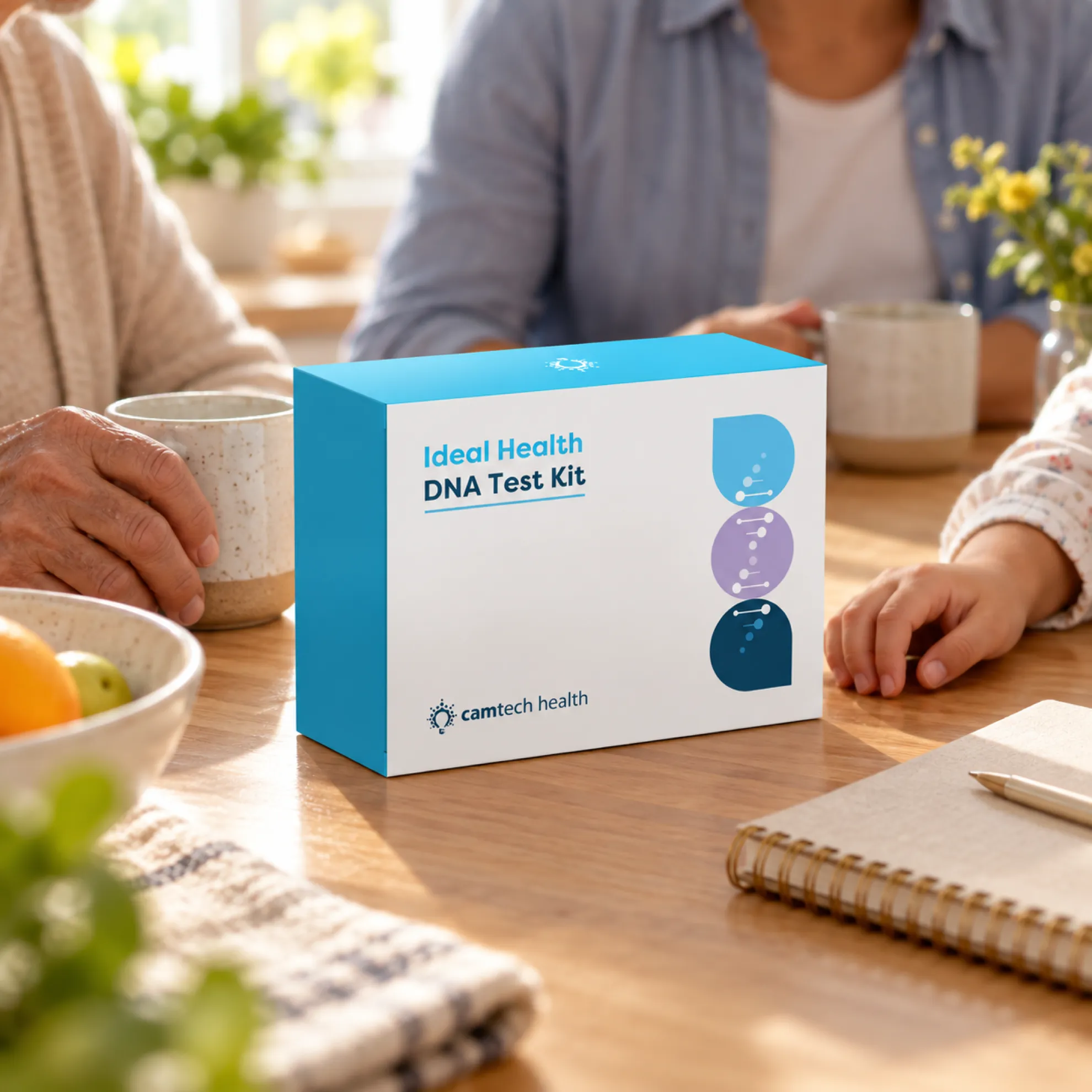
For example, the Camtech Health IDEAL Health DNA Test uses an at-home saliva sample and provides personalised information on selected traits. Camtech's product disclaimer states that the test is for general lifestyle insight and is not intended to assess, detect, diagnose, manage or treat a disease or medical condition. Product availability varies by region, so readers should check the current page and applicable local requirements before ordering.
If your main concern is a strong family pattern, symptoms, a previous diagnosis or a known genetic variant in a relative, begin with a qualified healthcare professional or genetic counsellor rather than relying on a lifestyle report.
Questions to ask before DNA testing
- What is this test intended to tell me?
- Which genes, variants or traits does it examine?
- What can a positive, negative or uncertain result not tell me?
- Would an important finding need confirmation in a clinical laboratory?
- Is genetic counselling or another form of professional support available?
- How will my sample and genetic data be stored, shared or deleted?
- Is the test available and appropriate in my country?
These questions help turn genetic information into a considered decision rather than a source of false certainty.
References
- Family Health History and Adults, US Centers for Disease Control and Prevention.
- Genetic Testing, US Centers for Disease Control and Prevention.
- Direct-to-Consumer Tests, US Food and Drug Administration.
- Risks and Limitations of Genetic Testing, MedlinePlus Genetics, US National Library of Medicine.
- IDEAL Health DNA Test, Camtech Health.
Medical disclaimer
This article is for general educational purposes only and does not replace personalised medical advice, diagnosis or treatment from a qualified healthcare professional. Genetic and screening guidance, test availability and privacy protections vary by country. Discuss personal or family health concerns and any test results with an appropriately qualified professional, and continue routine care according to local guidance.
*Visuals are assisted by artificial intelligence (AI)
Frequently asked questions
Is family history the same as genetic risk?
No. Family history reflects shared genes, environments, behaviours and healthcare experiences across relatives. Genetic risk refers to information associated with particular genetic variants. The two can overlap, but they are not interchangeable.
Can a DNA test replace my family health history?
No. A DNA test examines only the variants or traits included in that test, while family history can reveal broader patterns. Healthcare professionals may use both sources alongside your personal history, age and other factors.
Does a negative DNA result mean I have no inherited risk?
Not necessarily. A test may not cover every relevant variant, and many conditions involve several genes plus environmental and lifestyle factors. Continue recommended check-ups and screening according to local guidance.
When should I speak with a genetic counsellor?
Consider professional guidance if several close relatives have the same or related conditions, a condition appeared unusually early, a relative has a known genetic variant, or a test result could affect medical decisions or other family members.
Where does a lifestyle DNA test fit?
A lifestyle DNA test may provide information about selected traits and support informed questions. It is not a diagnosis and should not replace clinical testing, routine screening or advice from a qualified healthcare professional.