Food Sensitivity, Intolerance or Allergy: Where DNA Fits
By Stuart Chan
If a food seems to leave you bloated, itchy or unwell, it is natural to ask whether the problem is a food allergy, food intolerance or "food sensitivity" - and whether a food sensitivity DNA test can tell you why. These terms are not interchangeable, and a DNA wellness result cannot diagnose a current reaction.
A useful way to frame it is this: a clinical allergy assessment asks what may be happening in your body now; DNA analysis looks at selected inherited markers associated with potential predisposition. The two approaches answer different questions.
This guide explains where DNA insights may fit, what they cannot tell you, and how to use any result without making unsafe assumptions.
Short answer: A genetic predisposition is not a diagnosis. Use a DNA result as background information for observation and professional discussion, not as permission to remove foods or as proof that a food is safe.
First, separate the three terms
Food allergy
A food allergy involves the immune system reacting to a food. The National Health Service (NHS) explains that symptoms can include itchy skin or hives, swelling of the lips, face or eyes, coughing, wheezing, breathing difficulty, tummy pain, vomiting or diarrhoea. Some reactions can be serious. If you suspect an allergy, a qualified healthcare professional can assess your history and decide whether skin prick testing, blood testing or another clinical approach is appropriate.
Food intolerance
A food intolerance is different from a food allergy. It commonly involves difficulty digesting or processing a food or ingredient rather than the immune system overreacting. The NHS describes symptoms such as bloating, gas, tummy pain, diarrhoea, feeling sick, headache or tiredness. Symptoms may appear later and can have many possible causes.
"Food sensitivity"
Food sensitivity is a broad everyday phrase, not always a precise medical diagnosis. People may use it to describe digestive discomfort, skin changes, headaches or other symptoms after eating. The label alone does not tell you what mechanism is involved or what a particular test measures.
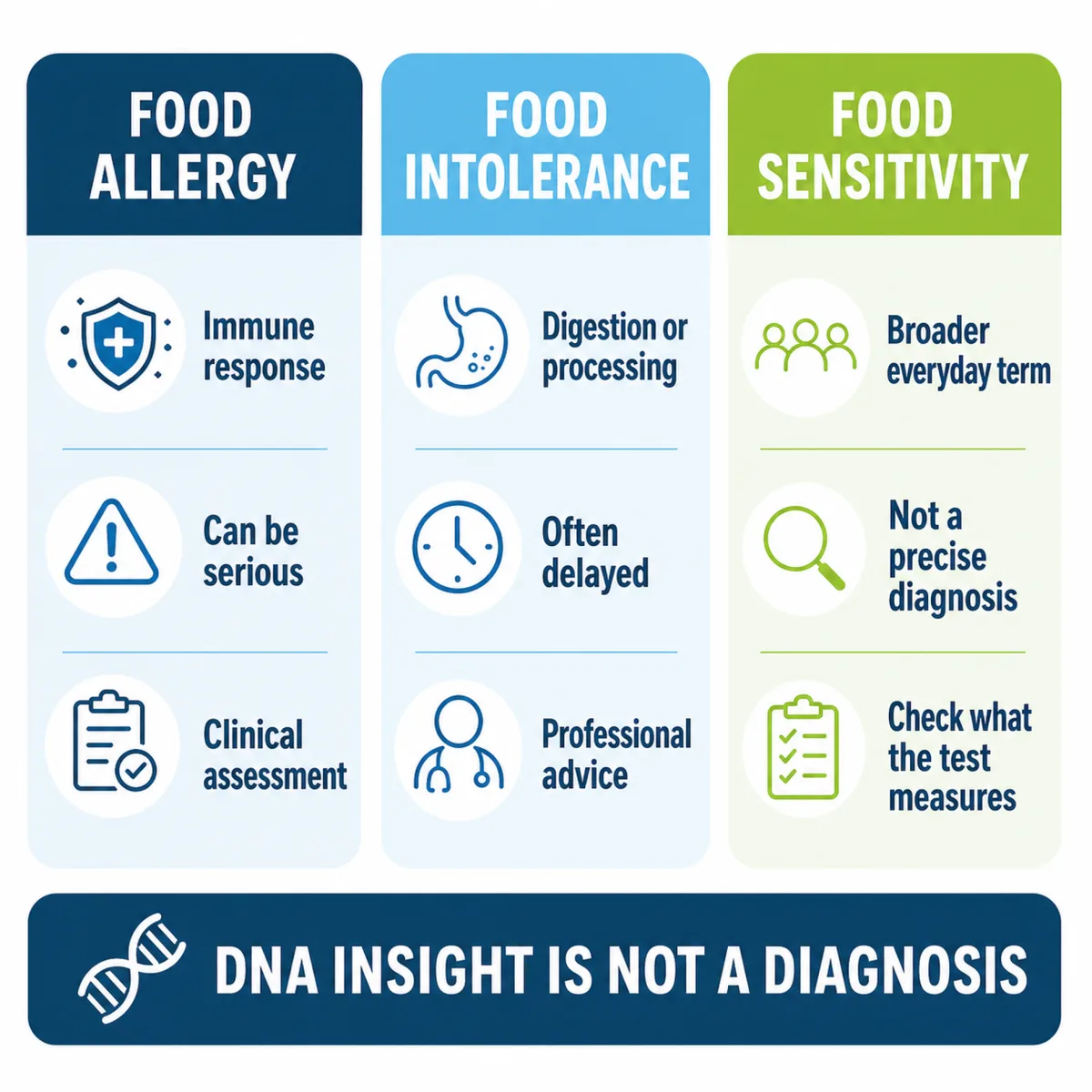
A further distinction matters. The American Academy of Allergy, Asthma & Immunology (AAAAI) advises against using immunoglobulin G (IgG) food panels to diagnose food allergy or food intolerance/sensitivity. A DNA test and an IgG panel measure different things, so check the test method and purpose before acting on a result.
Where DNA fits
Your deoxyribonucleic acid (DNA) is inherited biological information. Genetic variation can be one part of the picture, alongside environment, exposure, immune response, health history and other factors. Food allergy is complex; genetic predisposition may contribute to risk, but it does not guarantee that a reaction will occur.
MedlinePlus Genetics explains that direct-to-consumer genetic tests are often intended to provide information rather than diagnose, prevent or treat a condition. Results are usually estimates of likelihood, not a yes-or-no answer. A higher-risk result does not mean you will definitely develop symptoms, and a lower-risk result does not rule out a reaction.
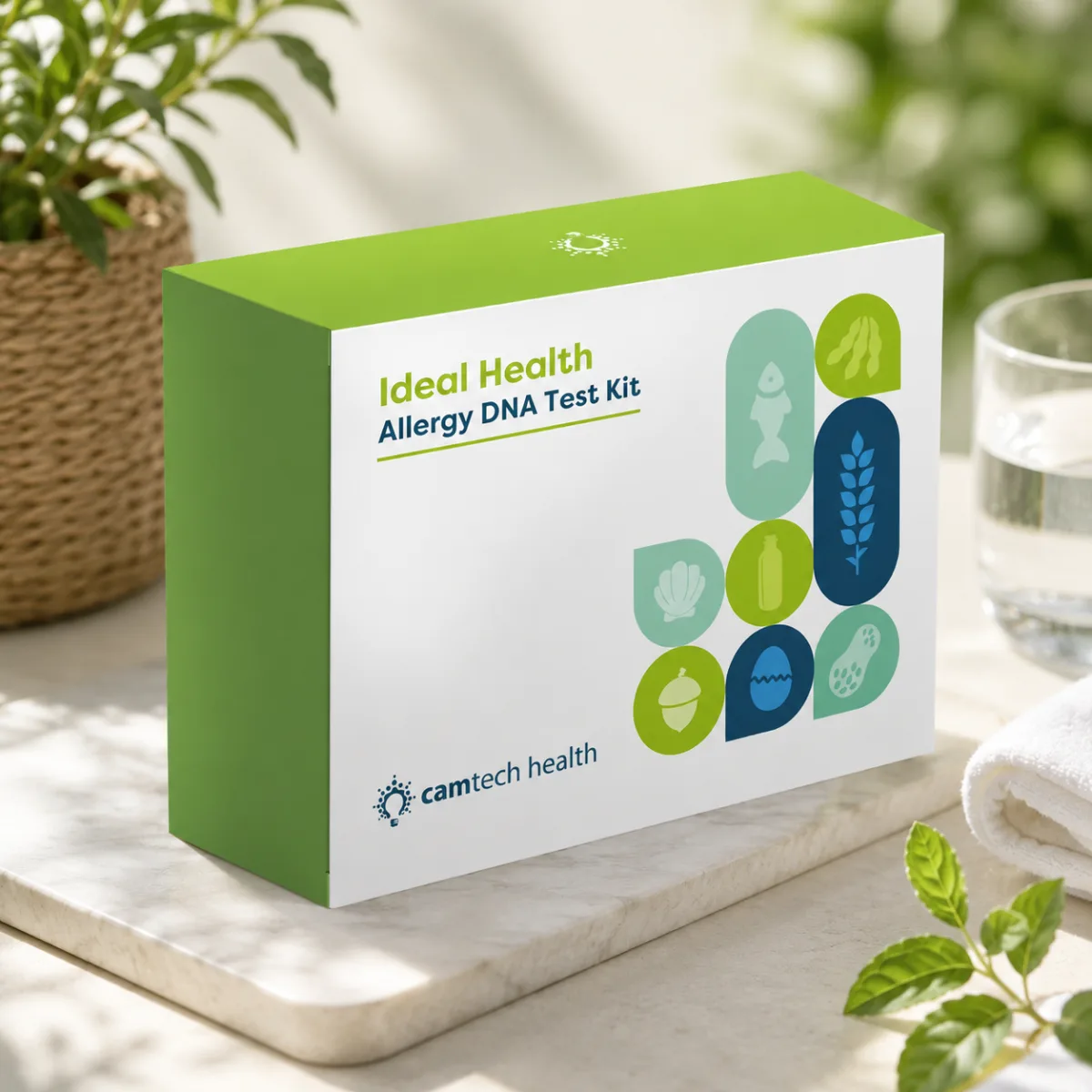
At Camtech Health, our IDEAL Allergy DNA Test is described on our current product page as an at-home saliva test that screens selected genetic variations linked to potential risk across food, plant, airborne and chemical allergen categories. Our product information also states that the test is not intended to assess, detect, diagnose, manage or treat a disease or medical condition. Follow the current product information and the Instructions for Use (IFU) supplied with your kit.

What an allergy DNA test may help you do
Used with the right expectations, a result may help you:
- Notice areas of inherited predisposition that you want to understand better.
- Ask more focused questions about symptoms, timing, diet or environmental exposure.
- Decide what to observe more carefully before a conversation with a doctor, dietitian or allergy specialist.
- Think about practical wellness habits without treating the result as a diagnosis.
The useful question is not "Which foods must I stop eating?" It is "What does this test measure, and what should I discuss with a qualified healthcare professional?"
What a food sensitivity DNA test cannot tell you
A DNA result cannot:
- diagnose a current food allergy or confirm a food intolerance;
- identify with certainty which food caused symptoms today;
- tell you how much of a food is safe to eat after a reaction;
- predict with certainty whether you will develop symptoms later;
- replace clinical assessment, medical testing or urgent care.
Do not deliberately re-expose yourself to a food that has caused a serious reaction just to compare it with a DNA report. If a food triggers swelling of your mouth, lips, tongue or throat, breathing difficulty, fainting, severe dizziness or other signs of a serious allergic reaction, seek urgent help through your local emergency service.
A safer way to use your result
1. Check the test's purpose and method
Read the report and product information carefully. Look for what was measured, which categories are covered, how the result is described and what the limitations are. "Genetic predisposition", "immune response", "intolerance" and "diagnosis" are not interchangeable.
2. Keep a food and symptom diary
If symptoms recur, record what you ate, the portion, timing, symptoms, severity, sleep, stress, exercise, medicines and relevant environmental exposure. A clear timeline can help a healthcare professional consider food allergy, intolerance and other possible explanations.
3. Do not make broad diet changes on your own
The NHS advises against cutting foods out without professional advice. Removing several food groups can create nutritional gaps and may make it harder to work out what is actually happening. Speak with a doctor or registered dietitian before making major changes, especially for a child, during pregnancy or if you have another health condition.
4. Get clinical advice for recurring or worrying symptoms
A professional can interpret symptoms in context and decide whether allergy testing, dietary review, monitoring or another assessment is appropriate. A clinical test may assess a different part of the question from a DNA wellness test.
5. Treat emergency symptoms as an emergency
A report should never delay urgent care. If symptoms are severe, rapidly worsening or involve breathing, collapse or swelling of the mouth or throat, seek local emergency help immediately.

How Camtech Health fits into the wider picture
At Camtech Health, our role is to make selected health and wellness information easier to access. Our IDEAL Allergy DNA Test uses at-home saliva collection and digital reporting for allergy-related genetic predisposition insights as described on our product page.
That information is most useful when it is kept in context. It can support awareness and better questions, while symptoms, personal history and professional guidance remain important for decisions about diagnosis, diet and treatment.

The takeaway: use DNA as a guide, not a verdict
Food allergy, food intolerance and the everyday term "food sensitivity" describe different ideas. A DNA result may provide information about selected inherited predispositions, but it does not confirm what is causing a current symptom and it does not replace clinical assessment.
The safest next step is to read what the test measures, observe patterns carefully and discuss meaningful concerns with a qualified healthcare professional. Use the report to ask better questions - not to make a diagnosis or to take risks with food.
Patient frequently asked questions
Can a food sensitivity DNA test diagnose a food allergy?
No. A DNA test may provide information about selected inherited predispositions, but it cannot diagnose a current food allergy. Diagnosis requires appropriate clinical assessment by a qualified healthcare professional.
What is the difference between a food intolerance and a food allergy?
A food allergy involves an immune response and can sometimes be serious. A food intolerance commonly involves difficulty digesting or processing a food or ingredient. Symptoms can overlap, so a professional assessment may be needed.
Does a higher genetic predisposition mean I will definitely react?
No. Genes are one part of the picture. Environment, exposure, immune response, health history and other factors can influence whether symptoms occur. A lower-risk result does not rule out a reaction.
Should I cut out foods after receiving a DNA result?
Not without advice. Speak with a doctor or registered dietitian before making major dietary changes, especially if you are removing several food groups or managing symptoms in a child.
How should I use my allergy DNA test results?
Use them as a starting point for awareness, symptom tracking and professional discussion. Check what the test measures and its limitations, and do not use it as a replacement for clinical testing or urgent medical care.
Medical Disclaimer
This article is for general education only and does not replace advice, diagnosis or treatment from a qualified healthcare professional. A DNA wellness result is not a clinical diagnosis and should not be used as the only basis for changing your diet, interpreting a reaction, starting or stopping treatment, or delaying urgent care. Product availability, intended use and regulatory status may vary by market. Follow current product information and local healthcare guidance. *Visuals are assisted by artificial intelligence (AI)
References
- NHS: Food allergy
- NHS: Food intolerance
- American Academy of Allergy, Asthma & Immunology: The myth of IgG food panel testing
- MedlinePlus Genetics: What do the results of direct-to-consumer genetic testing mean?
- National Center for Biotechnology Information (NCBI) Bookshelf: Food Allergies
- Camtech Health: IDEAL Allergy DNA Test