
Men’s Health Month in Singapore: Making Screening Easier
By Stuart Chan

If Men’s Health Month prompts you to think about your health, start with one manageable conversation rather than a large, all-in-one package. A family doctor can help you review your age, family history, existing conditions and when your last check was done.
Screening is for people who feel well and aims to identify possible health risks before symptoms appear. It is different from diagnostic testing, which investigates a symptom or abnormal finding. If you already have chest pain, severe breathlessness, blood in your urine or stool, sudden weakness, or another worrying symptom, seek medical assessment rather than waiting for a screening appointment.
Why men put screening off
The barrier is not always a lack of concern. Screening can feel vague, time-consuming or uncomfortable. Some men worry that one test will lead to many more, while others are unsure which checks are genuinely useful.
A practical way through that uncertainty is to replace the question “Which package should I buy?” with “Which health risks are relevant to me now?” Singapore’s evidence-based screening framework separates tests suitable for population-level screening from those that should be decided individually with a doctor.
Start with the checks that fit your age and risk
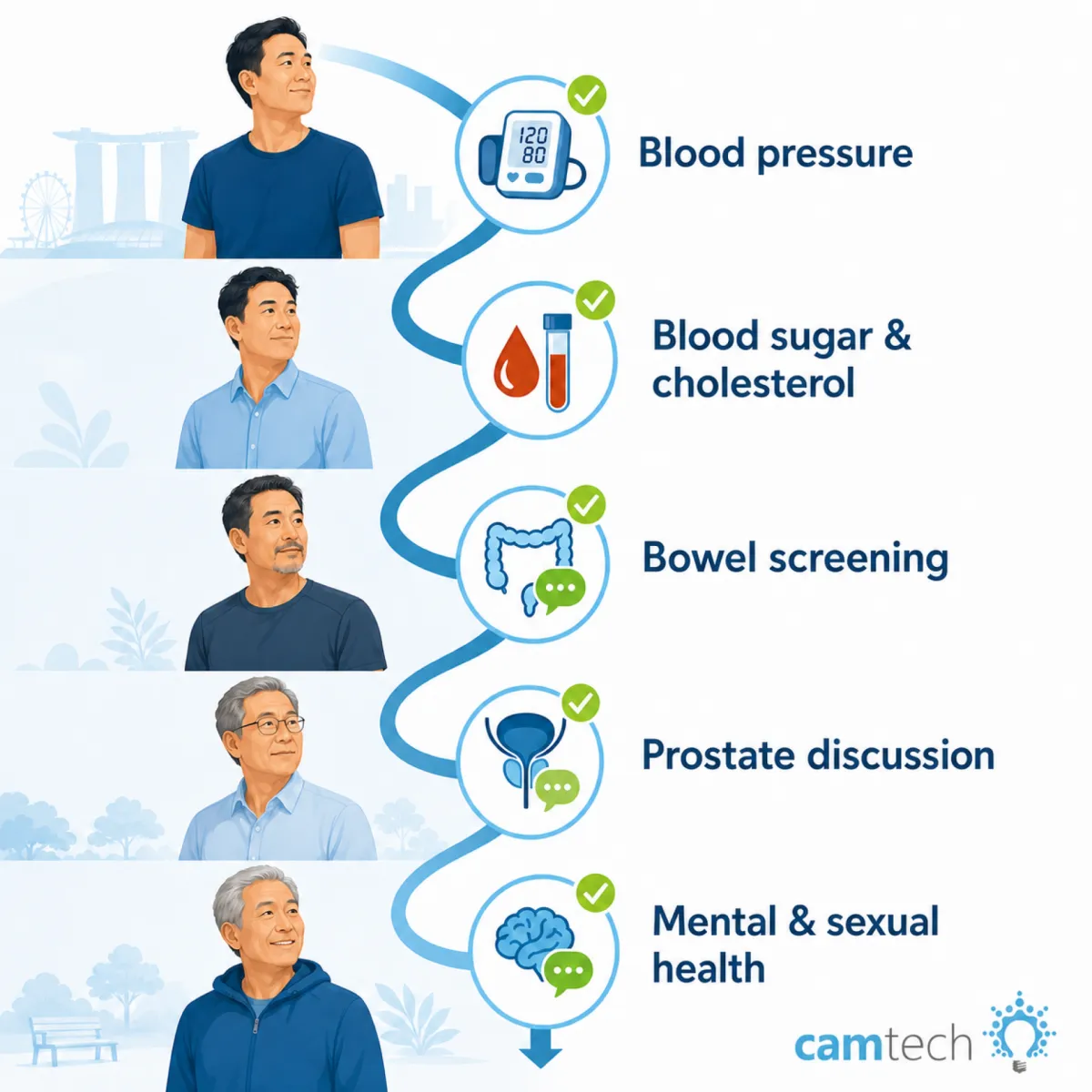
There is no single screening list for every man. The following is a conversation guide, not a personal prescription.
| Health area | A useful starting point | What to remember |
|---|---|---|
| Blood pressure and body measurements | Ask when these were last checked, even if you feel well | High blood pressure may not cause noticeable symptoms |
| Diabetes and cholesterol | Discuss blood testing from age 40, or earlier if your doctor identifies risk factors | Existing chronic conditions need ongoing monitoring, not repeated screening |
| Colorectal cancer | From age 50, ask about faecal immunochemical testing or whether another pathway suits you | Family history, polyps or bowel disease may change when and how screening begins |
| Prostate health | Discuss urinary symptoms, family history and the benefits and limitations of prostate-specific antigen testing | A raised PSA result is not a cancer diagnosis and may lead to further assessment |
| Mental and sexual health | Raise persistent low mood, anxiety, sexual symptoms or exposure concerns directly | These are legitimate health concerns and do not need to wait for an annual check |
The Healthier SG Screening programme can help eligible Singapore Citizens identify recommended subsidised screening based on age, sex, health history and previous screening. Your enrolled Healthier SG clinic or a participating Community Health Assist Scheme (CHAS) general practitioner (GP) clinic can check what is due.
Make the first appointment smaller

You do not need to solve every health question in one visit. A manageable first appointment can have three goals:
- review your personal and family history;
- identify one or two checks that are due; and
- agree on how results and follow-up will be handled.
Before the visit, write down current medicines, major family health conditions, previous screening dates and any symptoms you have been minimising. If embarrassment is a barrier, open with a direct sentence such as, “I have been putting this off and I want to know what is appropriate for me.”
Understand what a screening result can and cannot tell you
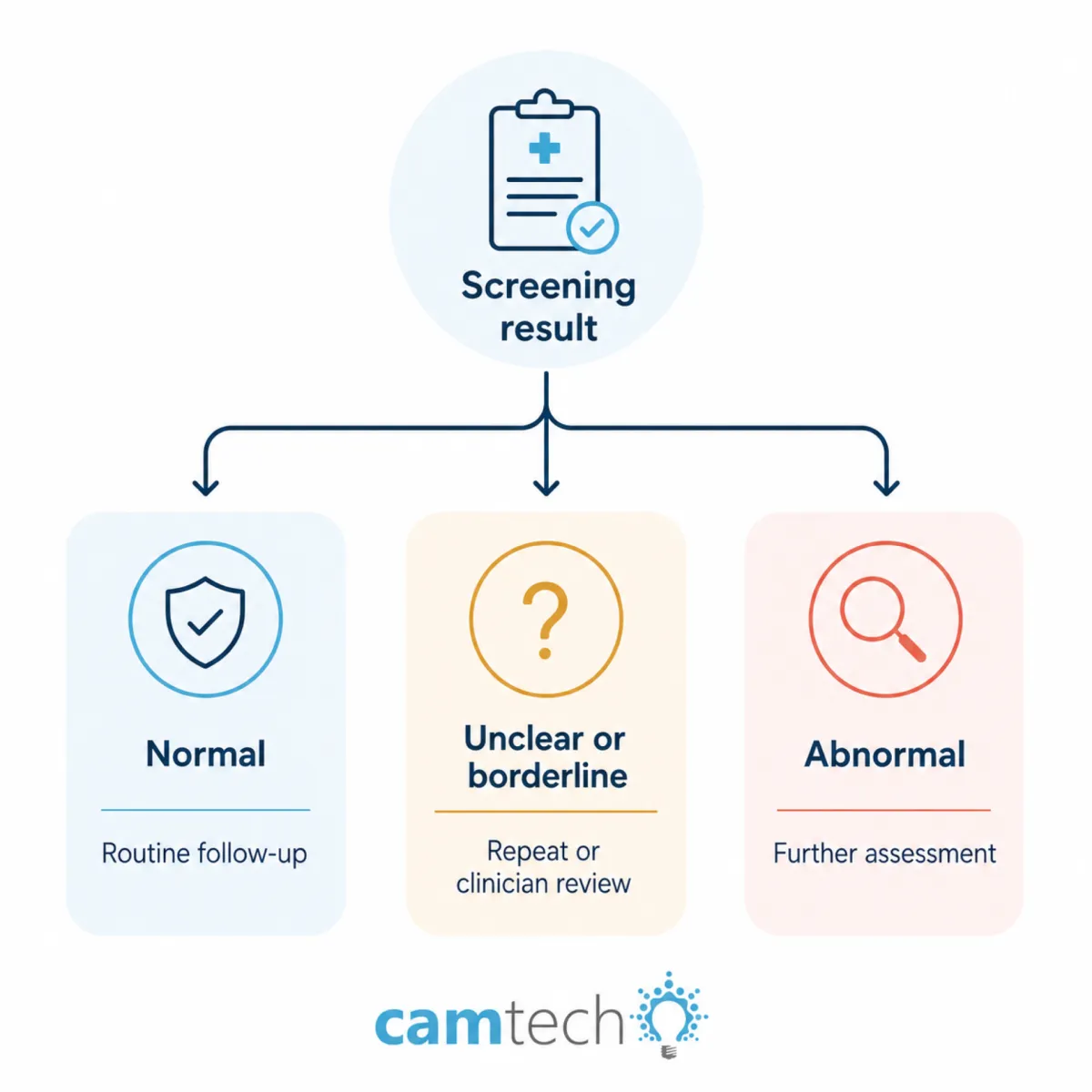
A normal result means that the test did not identify the condition or risk marker at that time. It is not a lifetime guarantee. An abnormal result also does not always mean that you have a disease. It may require a repeat test, a clinical assessment or a more specific investigation.
Prostate screening is a good example of why context matters. The National Cancer Centre Singapore overview of prostate screening explains that PSA results can be affected by non-cancerous conditions and should be interpreted alongside individual risk and clinical findings. Discuss the potential benefits and limitations with a doctor before testing.
Use convenience without losing clinical context
Home-based collection or self-testing can make some health questions easier to address, particularly when privacy, travel or appointment time is a concern. The Camtech Health Singapore platform provides examples of locally available at-home and laboratory-supported health tests.
Convenience does not make every test suitable for every person. Check the intended use, follow the instructions exactly and plan what you will do for a positive, negative, invalid or unexpected result. Do not use a home test to rule out a serious condition when symptoms are present, and do not delay medical care because a result appears reassuring.
Turn screening into a follow-up plan
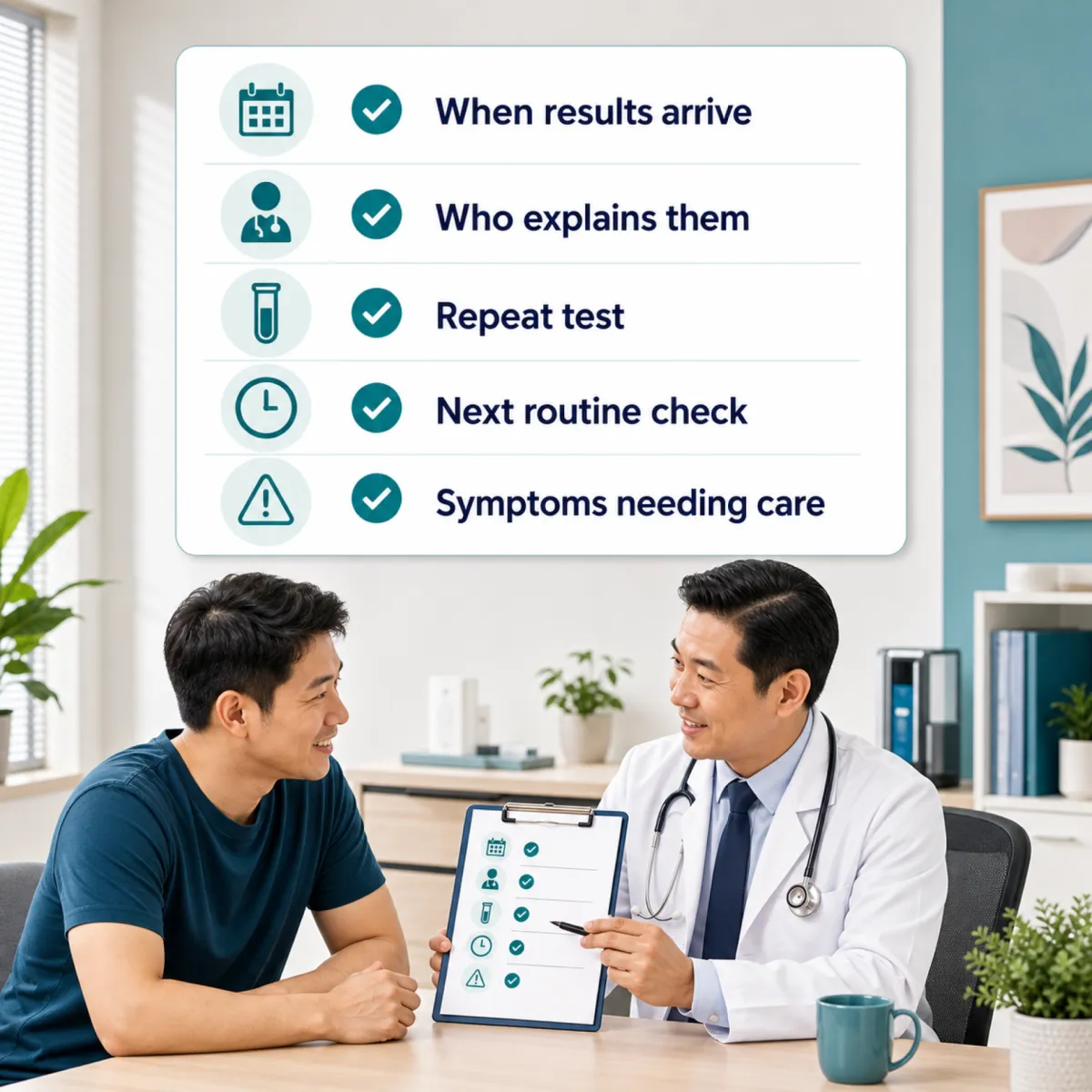
The most useful screening process ends with a next step. Before you leave a clinic or submit a sample, know:
- when and how the result will arrive;
- who will explain it;
- what requires repeat testing or follow-up;
- when the next routine check is due; and
- which symptoms should prompt earlier care.
The aim during Men’s Health Month is not to complete every possible test. It is to make one appropriate start and close the loop after the result.
References
- Ministry of Health Singapore. Healthier SG Screening
- HealthHub. Healthier SG Screening - National Health Screening Programme
- HealthHub. Evidence-based Recommendations on Health Screening Tests
- National Cancer Centre Singapore. Prostate Cancer Screening
Important information
This article provides general educational information and does not replace personalised advice, diagnosis or treatment from a qualified healthcare professional. Screening needs depend on age, symptoms, family history, existing conditions and previous results. Seek prompt medical attention for severe, sudden or persistent symptoms, and discuss unclear or abnormal results with a healthcare professional.
*Visuals are assisted by artificial intelligence (AI)
Frequently Asked Questions
I feel well. Do I still need screening?
Some conditions can develop without obvious early symptoms. Ask your family doctor which evidence-based checks are appropriate for your age, risk factors and previous screening history.
Should every man have a prostate-specific antigen (PSA) test?
Not automatically. PSA testing has potential benefits and limitations, and results can be affected by non-cancerous conditions. Discuss your age, family history, symptoms and preferences with a doctor before deciding.
Can an at-home test replace a clinic visit?
It depends on the test and the question being asked. Use only a test intended for your situation, follow its instructions and arrange medical follow-up when advised. Symptoms or urgent concerns need clinical assessment.
What if my screening result is abnormal?
An abnormal screening result is not always a diagnosis. Follow the stated next steps and speak with a healthcare professional about repeat testing or further assessment. Seek urgent care if you also have severe or rapidly worsening symptoms.