
Ovulation Test Results: Positive, Negative and Faint Lines
By Stuart Chan
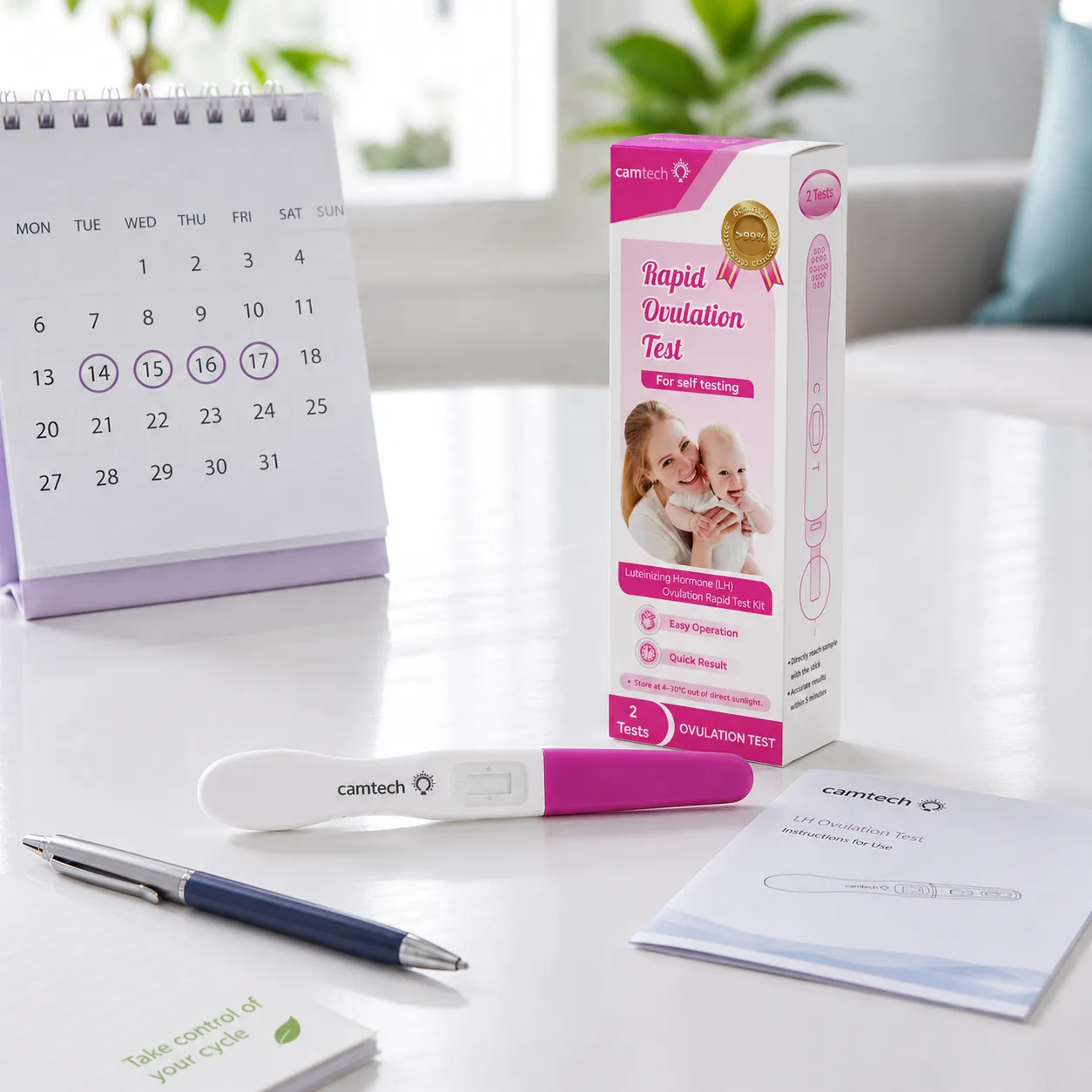
If you are staring at an ovulation test and wondering whether the second line "counts", you are not alone. The key is to compare the test line with the control line, read the result within the time stated in the instructions, and treat it as a sign of a possible luteinising hormone (LH) surge, not proof that ovulation or pregnancy has happened.
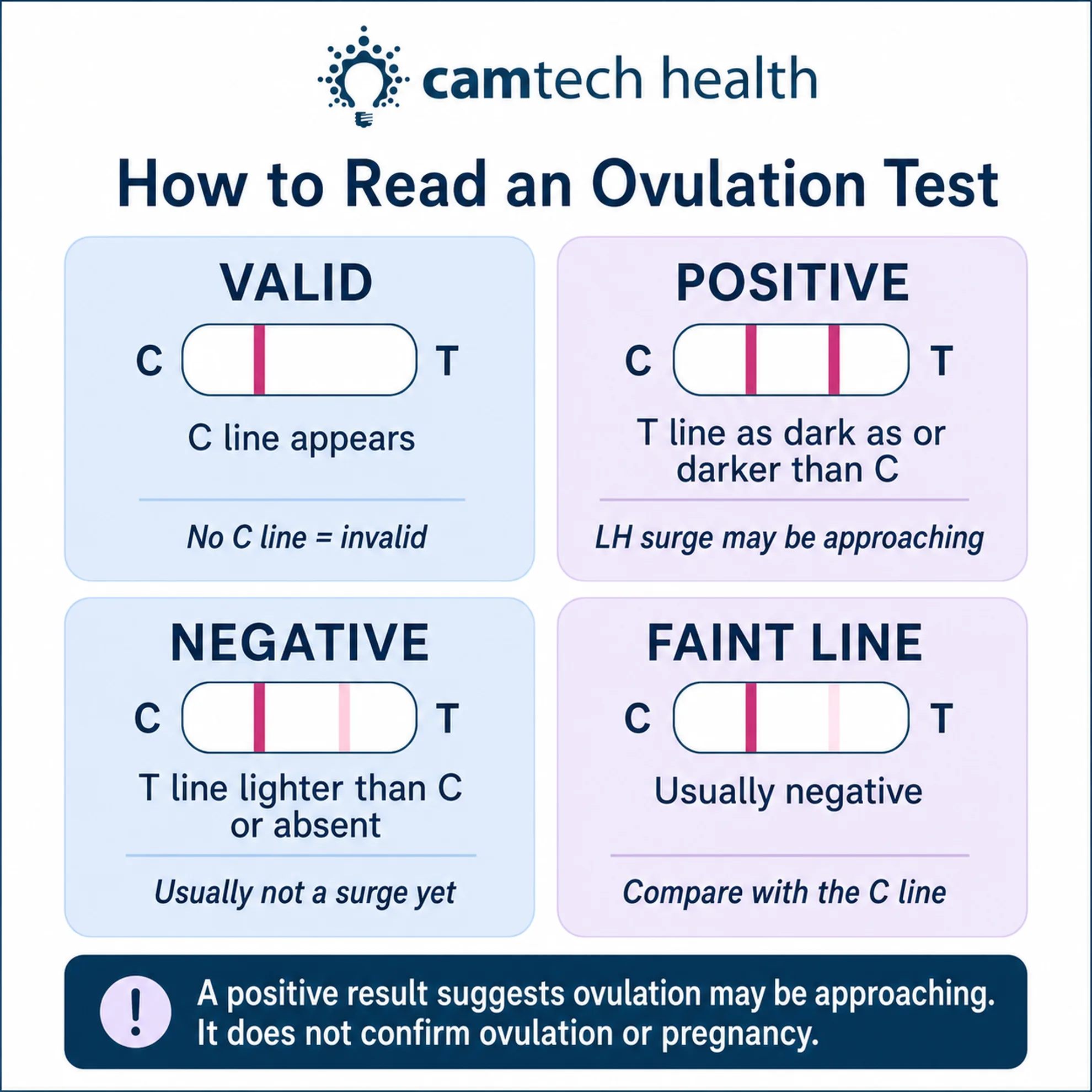
At Camtech Health, our LH Ovulation Test Kit gives a positive result when two visible lines appear and the test line is the same colour as or darker than the control line. A visible test line that is lighter than the control line is usually negative. The control line must appear for the result to be valid.
Compare the test line with the control line
Most line-based ovulation tests show a control line, marked C, and a test line, marked T. The control line shows that the test has run; the test line reflects the amount of LH detected in your urine at that moment.
Positive result
You see a control line and a test line that is as dark as or darker than the control line. This suggests that a possible LH surge has been detected. Our result guide describes probable ovulation in about 24 to 36 hours, but the timing is an estimate.
Negative result
You see a control line, with no test line or a test line lighter than the control line. The test has not detected an LH level high enough for a positive result at that time; it does not tell you that you will not ovulate later.
Invalid result
There is no control line, even if another mark appears. The result is invalid and cannot be interpreted. Follow the instructions for obtaining a new valid result.
Our LH Ovulation Test Kit is a urine-based test designed to help predict ovulation. The MedlinePlus explanation of home ovulation tests likewise explains that these tests detect a rise in LH in urine. Neither source treats a line result as a diagnosis of infertility, a pregnancy test or confirmation that an egg has definitely been released.
What does a faint ovulation test line mean?
If your test line is faint, it usually means that some LH is detectable, but the test line is not yet as dark as the control line. Under our interpretation guide, that is a negative result, not a positive one. A faint line can still be useful information when you compare it with results from other days.
This can feel confusing because LH is normally present at a lower level during much of the cycle. As your cycle approaches an LH surge, the test line may become darker. If it reaches the same intensity as the control line, or becomes darker, the result meets the positive interpretation for this type of test. A line can therefore be visible on several days without every day being a positive result.
Line darkness is not a measurement of your exact hormone level. A darker line does not tell you the precise amount of LH in your urine, and a faint line does not by itself diagnose a hormone problem. Compare the lines within the stated reading window and look at the pattern across the days you test.
Why can the line change from faint to dark?
LH changes during the menstrual cycle, so the line may look faint when LH is lower and become stronger as LH rises. It may then become lighter again after the surge has passed. The pattern is more useful than judging one line in isolation.
The timing of the rise is different for different people and can vary from cycle to cycle. A single negative test does not prove that you will not ovulate later in the cycle. The National Library of Medicine's MedlinePlus guidance notes that people may need to test for several days to detect a surge and may miss it if they miss a testing day.
Urine concentration can also affect how easy a line is to see. Drinking a large amount of fluid before testing can dilute the urine. Follow the instructions we supply with your kit about specimen collection, testing routine and reading window; do not change the procedure simply to make a line darker.
How to read an ovulation test step by step
Use the instructions we supply with our LH Ovulation Test Kit every time. At Camtech Health, our result guide states that the pictured test is exposed to urine for 10 to 15 seconds and read after five minutes. If our Instructions for Use (IFU) supplied with your pack give different directions, follow those instructions.
- Check the test and instructions. Confirm that the test is within its use-by date and that the pouch is intact. Read the package insert before opening the device.
- Collect or apply the urine as directed. Use the collection method shown in the instructions. Avoid making up a different dipping time or sample volume.
- Start a timer. Read the result at the time stated in the instructions. A result that changes after the reading window should not be used to reinterpret an earlier result.
- Find the C and T lines. First check that the control line is present. If it is missing, the result is invalid.
- Compare the line intensity. If the T line is as dark as or darker than the C line, record the result as positive for the test's LH-surge interpretation. If the T line is lighter, record it as negative.
- Record the result and date. A simple record can help you see whether the line is becoming stronger, whether your cycle timing varies and when to start testing in a later cycle.
The Health Sciences Authority's guidance on safe use of medical devices also emphasises following the instructions provided with a device. This matters because an invalid or poorly timed result cannot be made reliable by interpreting the line more closely.

What does a positive ovulation test mean?
A positive result means the test has detected an LH level that meets its positive threshold. The LH rise is a signal that ovulation may be approaching. Our result guide describes probable ovulation in approximately 24 to 36 hours. The American College of Obstetricians and Gynecologists (ACOG) explanation of infertility evaluation describes a positive urine test as suggesting that ovulation may occur within the next 24 to 48 hours.
These time ranges are estimates, not a guarantee. A positive result does not prove that ovulation will definitely occur, does not confirm the quality of an egg or guarantee conception. It also does not mean that you are pregnant: an ovulation test detects LH, while a pregnancy test looks for human chorionic gonadotropin (hCG), a different hormone.
If you are planning a pregnancy, a positive result can help you identify days when sex may be more likely to lead to conception. It does not confirm ovulation, guarantee pregnancy or work as contraception. If you have been trying to conceive, have concerns about your cycle or use fertility medicines, discuss your situation with a qualified healthcare professional.
Why you keep seeing faint or negative lines
If you keep seeing faint or negative lines, it can be frustrating, but a home test cannot tell you which explanation applies. Possible factors include:
- Testing too early or too late in the cycle. The LH rise may not have happened yet, or it may have passed before you tested.
- Testing on too few days. A short surge can be missed if testing is infrequent.
- Diluted urine. Large amounts of fluid before testing can make a line harder to see.
- Irregular cycles. Calendar estimates may not predict the day of an LH rise well when cycle length changes.
- Medicines or health conditions that affect hormones. Some medicines can alter LH levels, so ask a healthcare professional if you are unsure how your treatment may affect testing.
Do not respond to a faint line by repeatedly testing outside our product instructions or drinking less than is healthy. Use a consistent routine, record what you see and seek individual advice if the pattern remains unclear.
Positive, negative or invalid: what next?
If the result is positive
Record the date and follow your personal pregnancy-planning advice. Remember that the result predicts a possible fertile period; it does not confirm ovulation or pregnancy. If you are using a fertility treatment plan, follow your clinic's instructions rather than changing medication or appointment timing based only on a home line test.
If the result is negative or faint
Continue testing only as often and for as many days as our product instructions recommend. A faint line is not a reason to assume that something is wrong. Look for a change across the cycle, while remembering that some people may not see a clear positive in every cycle.
If the result is invalid
Do not interpret the visible mark. A missing control line means the test has not produced a valid result. Use a new device and follow the instructions carefully. If invalid results keep happening, contact the seller or manufacturer using the support details supplied with the product.

Does a positive result confirm ovulation?
No. An LH ovulation test is a prediction tool. It detects a hormone rise associated with the approach of ovulation, but it does not directly observe the release of an egg. Some cycles may have an LH rise without ovulation, and some people may find it difficult to capture the rise with urine testing.
If a clinician needs to assess whether ovulation is occurring, they may consider your menstrual history alongside other tests. The ACOG guidance describes different parts of an infertility evaluation, including urine LH testing and other clinical assessments. A home result should provide context for a conversation, not replace that conversation.

When to speak with a healthcare professional
Consider getting individual advice if your periods are repeatedly irregular, your usual pattern changes, you have unusual bleeding or pain, or you are struggling to become pregnant. The National Health Service (NHS) guidance on irregular periods advises speaking with a healthcare professional when periods are irregular or when a person is struggling to get pregnant.
You may also want to ask for advice if you cannot detect a surge across several cycles, if your results are repeatedly invalid or if you take medicines that may affect LH. A clinician can decide whether another method of cycle or fertility assessment is appropriate.
An ovulation test is not designed to diagnose infertility, polycystic ovary syndrome (PCOS), pregnancy or any other condition. It is a tracking tool, not a substitute for care if you have symptoms that need medical assessment.
References
- Camtech Health: Ovulation Test Kit Singapore
- MedlinePlus: Ovulation home test
- American College of Obstetricians and Gynecologists: Evaluating Infertility
- Health Sciences Authority: How medical devices are regulated and their safe use
- National Health Service: Irregular periods
Medical disclaimer
This article is for general education and does not diagnose ovulation, infertility, pregnancy or any other condition. Follow our Instructions for Use (IFU), and speak with a qualified healthcare professional about persistent irregular cycles, medicines or fertility concerns. Product availability and intended use are market-specific.
*Visuals are assisted by artificial intelligence (AI)
Frequently asked questions
Is a faint line on an ovulation test positive?
Usually not for a line-based test that requires the T line to be as dark as or darker than the C line. If your T line is lighter, the result is generally interpreted as negative.
What do two dark lines mean on an ovulation test?
If the C line is present and the T line is as dark as or darker than it, the result meets the positive interpretation shown in our result guide. It suggests an LH surge, not pregnancy.
Why is my ovulation test line always faint?
It may reflect a lower LH level, the timing of testing, diluted urine, an irregular cycle or a hormone-affecting medicine. Keep a consistent record and ask a healthcare professional if the pattern persists.
What if there is no control line?
The result is invalid and should not be interpreted. Use a new test and follow the supplied instructions. Contact the manufacturer or seller if invalid results continue.
Can an ovulation test tell me that I am pregnant?
No. An ovulation test looks for LH. Pregnancy tests look for hCG, so use a pregnancy test and seek appropriate advice if pregnancy is possible.