
Personal vs Legal Paternity Tests: At-Home Kits
By Stuart Chan

Paternity questions can be deeply personal. For some men, the concern may come from uncertainty, family conversations, or a private need for biological confirmation before deciding what to do next. In Singapore, at-home paternity test kits can provide a discreet way to collect DNA samples for personal informational use, without requiring a clinical visit.
However, it is important to understand one key distinction: a personal at-home paternity test is not the same as a legal paternity test. The difference is not only about where the sample is collected. It is also about identity verification, consent, documentation, and whether the result may be used in formal legal matters.
This article explains the difference in a clear and practical way, so you can choose the right option for your situation.
What Is a Paternity Test?
A paternity test compares DNA markers from a child and an alleged father to assess whether there is a biological father-child relationship. Most at-home kits use a cheek swab, also known as a buccal swab, which collects cells from inside the mouth.

For personal testing, the process is usually designed to be simple: collect the samples, follow the instructions, send the samples for analysis, and receive the report privately. HealthHub notes that direct-to-consumer genetic tests commonly involve sending a DNA sample, such as a cheek swab or saliva sample, to a provider for analysis. (HealthHub)
For Camtech Health customers, you may view the product here: Paternity Test Singapore.
Personal Paternity Test vs. Legal Paternity Test
The main difference is the purpose of the result.
A personal paternity test is intended for private informational use. It may help an individual better understand a biological relationship question before deciding whether to speak with family members, seek counselling, or consult a lawyer.
A legal paternity test is intended for use in formal proceedings, such as court-related matters involving child maintenance, custody, immigration, inheritance, or changes to official records. In Singapore, legal DNA testing generally requires stricter procedures, including identity verification and chain-of-custody documentation. SingaporeLegalAdvice explains that legal DNA tests are conducted when results are required to be admitted in court, while at-home tests are typically used for personal reassurance and are not court-admissible. (SingaporeLegalAdvice.com)
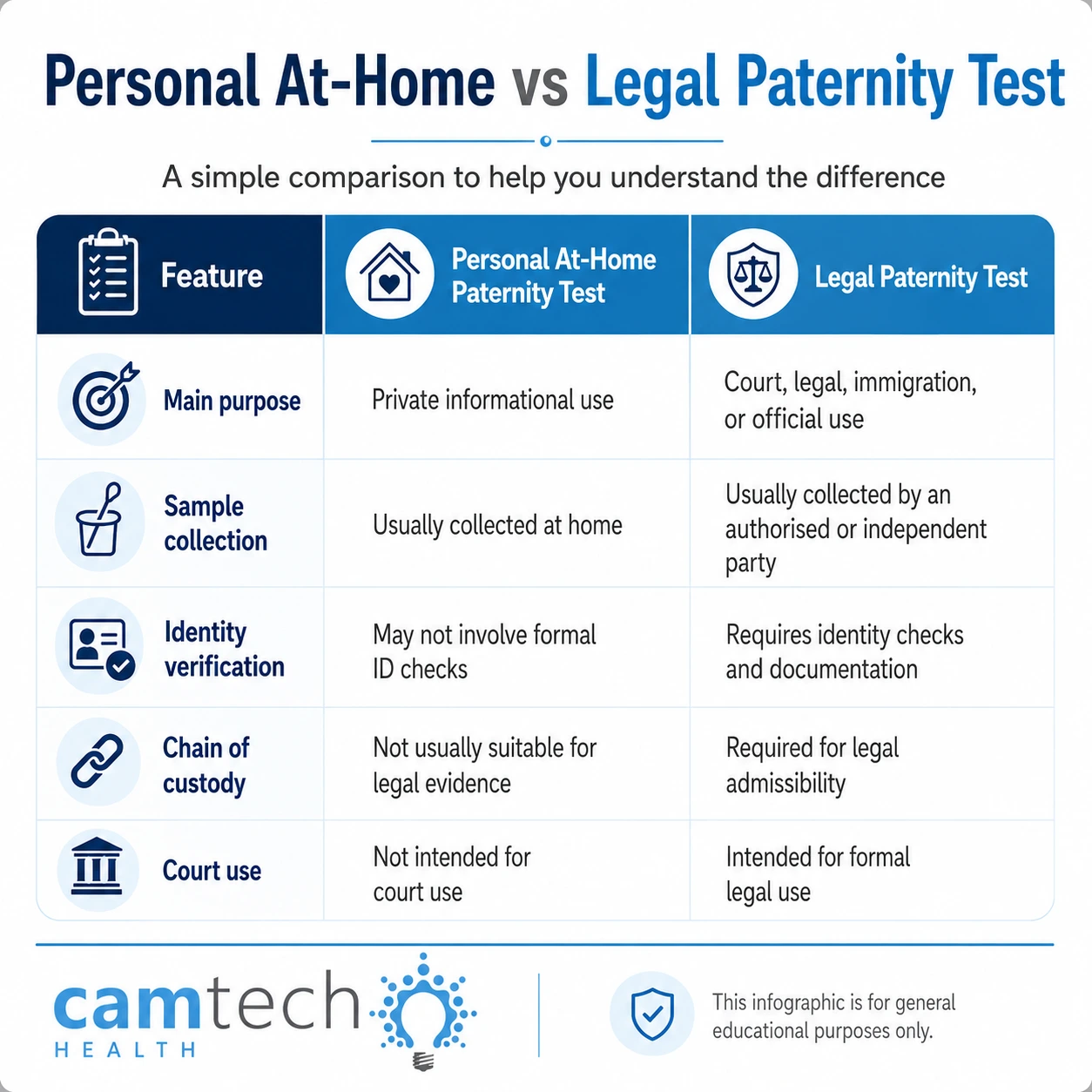
Simple Comparison
- Main purpose — Personal at-home test: private informational use. Legal test: court, legal, immigration, or official use.
- Sample collection — Personal at-home test: usually collected at home. Legal test: usually collected by an authorised or independent party.
- Identity verification — Personal at-home test: may not involve formal ID checks. Legal test: requires identity checks and documentation.
- Chain of custody — Personal at-home test: not usually suitable for legal evidence. Legal test: required for legal admissibility.
- Court use — Personal at-home test: not intended for court use. Legal test: intended for formal legal use.
Why Chain of Custody Matters
Chain of custody refers to the documented process that verifies who gave the sample, who collected it, how it was handled, and how it reached the laboratory.
This matters because legal authorities need confidence that the samples belong to the correct people and were not mixed up or substituted. SingaporeLegalAdvice notes that legal DNA samples are typically collected by an independent third party, such as a medical practitioner or qualified nurse, who witnesses and handles the sample collection process. (SingaporeLegalAdvice.com)
By contrast, an at-home paternity test is generally collected by the user in a private setting. This makes it more convenient, but it also means the result is usually not suitable as legal evidence.
When an At-Home Paternity Test May Be Suitable
An at-home paternity test may be suitable when the goal is private biological clarification rather than legal action.
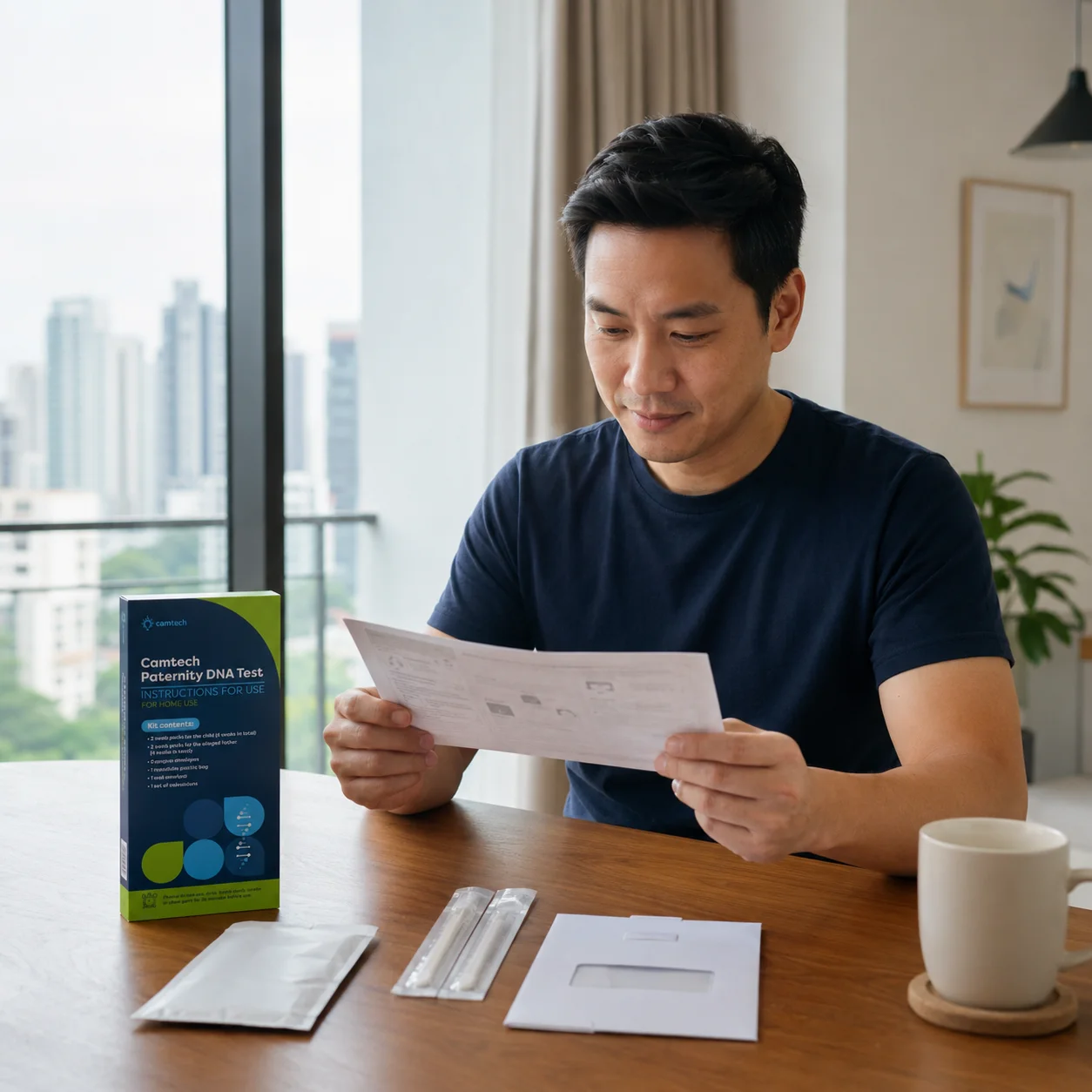
It may be considered when:
- A man wants personal confirmation before deciding on next steps.
- Family members prefer a private process before involving external parties.
- The result is needed for personal understanding, not for court submission.
- A discreet sample collection process is preferred.
- The individuals involved understand that the result is not intended for legal use.
This distinction is important. MOH has stated that consumers should exercise care when using direct-to-consumer genetic tests, particularly around privacy, interpretation, and the possible sharing or commercial use of genetic data. (Ministry of Health)
When You May Need a Legal Paternity Test Instead

You should consider legal advice or a formal legal DNA test if the result may be used for:
- Child maintenance claims
- Custody, care, or access matters
- Immigration applications
- Inheritance or estate matters
- Birth certificate or official record changes
- Court proceedings or formal disputes
In such cases, an at-home kit may not be enough. A legal test generally needs proper consent, identity verification, witnessed sample collection, and documented handling.
Consent and Privacy Should Not Be Treated Lightly
DNA data is sensitive because it may reveal information not only about the person being tested, but also about biological relatives. HealthHub advises consumers to review a provider’s terms and conditions, including how genetic data is stored, used, shared, and whether deletion can be requested. (HealthHub)
Before using any DNA paternity test, ensure that you understand:
- Who is being tested
- Whether consent is required from each participant
- How samples should be collected
- How results will be delivered
- How personal and genetic data will be handled
- Whether the test is for personal use or legal use
For sensitive family matters, it may also be helpful to speak with a qualified professional, counsellor, or lawyer before taking action based on the result.
How an At-Home Paternity Test Usually Works
While instructions may vary by provider, the process typically involves:
1. Ordering the Test Kit
The user receives the test kit with sample collection materials and instructions.
2. Collecting Cheek Swab Samples
A cheek swab is usually rubbed gently inside the mouth to collect cells. Samples may be collected from the alleged father and child.
3. Sending the Samples for Analysis
The collected samples are packaged according to the kit instructions and sent for laboratory analysis.
4. Receiving the Report
The report is returned privately. For personal at-home testing, the report is intended for informational use only and should not be presented as legal evidence unless the provider has arranged a legally valid chain-of-custody process.
Choosing the Right Test for Your Situation
Before buying a paternity test, ask yourself one practical question:
Do I need this result for private understanding, or for legal action?
If the answer is private understanding, an at-home paternity test may be a practical option. If the answer involves court, immigration, maintenance, custody, inheritance, or official documentation, you should seek legal advice and use a legal DNA testing process.
Camtech Health’s Paternity Test is positioned for personal informational use. You can also explore other health-related test options through the Camtech Health Singapore website.
Conclusion
At-home paternity tests can offer a private and convenient way to seek biological clarification. They may be useful for men who want personal confirmation without arranging a clinical appointment.
However, they should not be confused with legal paternity tests. If a result is needed for court, immigration, maintenance, inheritance, or official records, a formal legal DNA test with proper chain-of-custody procedures is usually required.
Understanding this difference helps protect everyone involved and ensures the test is used for the right purpose.
Singapore-Compliant Medical Disclaimer
This article is for general educational information only and should not be treated as medical, legal, or professional advice. At-home paternity tests are intended for personal informational use unless explicitly stated otherwise by the provider and supported by the required legal procedures. If you require a DNA test for court, immigration, child maintenance, custody, inheritance, or official documentation, please seek advice from a qualified lawyer or relevant professional in Singapore. For health-related concerns, consult a registered medical practitioner.
References
- HealthHub Singapore, “Understanding direct-to-consumer genetic tests.” (HealthHub)
- Ministry of Health Singapore, “Direct-to-consumer genetic testing services.” (Ministry of Health)
- SingaporeLegalAdvice, “A Guide to Legal DNA Testing in Singapore.” (SingaporeLegalAdvice.com)
Patient FAQ
1. Can I use an at-home paternity test result in Singapore court?
Usually, no. A personal at-home paternity test is generally intended for private informational use. If the result is needed for court or official purposes, a legal DNA test with identity verification and chain-of-custody procedures is usually required.
2. What is the difference between a personal and legal paternity test?
A personal paternity test is used for private understanding. A legal paternity test is designed for formal use in court, immigration, maintenance, custody, or official documentation matters. The legal version typically requires witnessed sample collection and formal identity checks.
3. Is a cheek swab painful?
No. A cheek swab is usually non-invasive. It involves gently rubbing a swab inside the cheek to collect cells for DNA analysis.
4. Should I speak to a lawyer before doing a paternity test?
If the result may affect child maintenance, custody, immigration, inheritance, or official records, it is advisable to seek legal advice before testing. This helps ensure the correct type of test is used from the start.