
Reading an HPV Test Report: Positive, Not Detected, High-Risk and Invalid Results
By Stuart Chan
If you have opened an HPV test report and felt unsure what to make of it, start with the exact wording rather than the most alarming word on the page. “Positive”, “not detected”, “high-risk” and “invalid” are not interchangeable. In a screening report, they describe what the laboratory could or could not find in the submitted sample; they do not, by themselves, diagnose cervical cancer or tell you that every part of your body is free of HPV.
This guide translates the common result terms into plain language and gives you a practical next step for each one. Keep your full report beside you as you read: its wording and the follow-up recommended by the service that tested your sample take priority. If you have symptoms, do not wait for a screening result to decide whether you need medical attention.
First, check what your report is testing
Human papillomavirus (HPV) is a group of common viruses. A high-risk HPV result refers to a type associated with a higher chance of cervical-cell changes if the infection persists. It does not mean that cancer is present now.
An HPV test and a Papanicolaou (Pap) test are related but different. An HPV test looks for covered high-risk HPV types in a collected sample. A Pap test examines cervical cells for abnormal changes. The National Cancer Institute’s explanation of HPV and Pap results explains why a positive HPV result and an abnormal Pap result are not the same finding.
Your result applies to the sample you provided and the HPV types included in that particular test. It is not a test for HPV everywhere in the body, and it cannot tell you when an infection was acquired or from whom.
At Camtech Health, our current Singapore at-home HPV test information describes a screening pathway using a self-collected vaginal sample. Our Instructions for Use (IFU) explain how to collect, label and return the sample. Our test is not a substitute for an examination, a Pap test when one is indicated, or follow-up care.
“Not detected” or “negative”
What it usually means
“Not detected” generally means that the test did not detect the covered high-risk HPV types in the submitted sample at the time it was tested. Some reports use “negative” for the same type of result.
This can be reassuring, but it is not a lifetime guarantee. The result does not mean that you can never acquire HPV, that a different HPV type outside the panel is absent, or that a new symptom has been explained. It also does not remove the need for future cervical screening.
What to do next
Continue screening according to the advice that applies to your age, previous results and health history. HealthHub’s current Singapore screening journey describes a Pap test every three years for women aged 25 to 29 who have ever had sex and an HPV test every five years for women aged 30 and above who have ever had sex. Your healthcare professional may recommend a different plan if your history or circumstances call for it.
If you have bleeding, unusual discharge, pelvic pain, pain during sex or a new lump or sore, do not use a not-detected result to dismiss it. Screening is intended for people who feel well. Symptoms need a clinical assessment, even when your latest result was not detected.
“Positive” or “detected”
What it usually means
Seeing “positive” or “detected” can be worrying, but it means only that the test found at least one covered high-risk HPV type in the submitted sample. It is a screening result, not a diagnosis of cervical cancer. Many HPV infections clear naturally, while persistent high-risk infection can require monitoring or further assessment.
A positive result after an earlier not-detected result does not prove that the infection is new. Your report cannot normally tell whether HPV was acquired recently or became detectable again after a period of being unnoticed. One result cannot tell you anything reliable about a partner or relationship, so avoid using it to make assumptions or assign blame.
What to do next
If your report says positive or detected, follow its instructions and arrange the recommended follow-up. The next step may depend on the genotype reported, your age, previous screening results, symptoms, immune status and the local screening pathway. It may involve a repeat test, a Pap test, a specialist review or colposcopy, a close examination of the cervix using a magnifying instrument.
The word “high-risk” can sound more frightening than it is meant to. Singapore’s HealthHub guidance explains that a high-risk HPV result does not mean cervical cancer is present, but follow-up assessment is important. Because the route can differ by genotype, age and history, discuss the complete report with the provider rather than relying on the single word “positive”.
If your result came from an at-home service, contact the service or healthcare professional named in the report. Keep the complete report, including any genotype information and comments, so the person advising you can see the context instead of a single word.
“High-risk HPV” or a genotype listed separately
“High-risk” is a screening category, not a statement that you have cancer now or that a symptom is severe. The concern is that some high-risk types can persist and contribute to cervical-cell changes over time, which is why the recommended follow-up matters.
Your report may list a genotype such as HPV 16 or HPV 18 separately, or show a group of other high-risk types. This detail helps a healthcare professional interpret your result and choose the appropriate follow-up. It still does not confirm that abnormal cervical cells or cancer are present.
At Camtech Health, our Singapore product information explains that our current HPV test panel covers high-risk genotypes and may report selected genotypes individually or group other types, depending on the report. Read the exact report wording and our Instructions for Use (IFU) rather than assuming that every HPV test uses the same panel or layout.
The World Health Organization’s guidance on HPV self-sampling emphasises that a positive self-sampling result needs a link to appropriate clinical assessment and treatment where indicated. Convenience can make screening easier to complete; it does not remove the need for follow-up.

“Invalid”, “inadequate” or “inconclusive”
What it usually means
If your result is invalid, inadequate or inconclusive, the laboratory could not issue a reliable detected or not-detected result from that sample. It is not the same as negative, and it is not proof that HPV is present.
The reason can vary, and your report or service may give more detail. It could relate to sample material, a sample-control problem, an error code or a technical processing issue. Because the repeat-sample process is specific to the test and laboratory, do not assume that a fixed waiting period or cause applies to you. Ask the service what to do next.
What to do next
Contact the service or healthcare professional named in the report and ask what should happen next. You may be advised to provide a repeat sample, check a collection or labelling step, or use another screening route. If a repeat collection is requested, follow our Instructions for Use (IFU) and make sure the sample belongs to the person registered for the test.
If you have symptoms, arrange medical assessment rather than waiting for a repeat screening result. An invalid report cannot reassure you about a symptom, and a screening test cannot replace an examination.
What an HPV screening result can and cannot tell you
Your HPV screening result can help show whether covered high-risk HPV types were detected in the sample you submitted. Depending on the product or laboratory, it may also provide genotype information that helps guide follow-up.
It cannot:
- diagnose cervical cancer;
- confirm that the cervix is healthy;
- show whether abnormal cervical cells are present unless a separate cell test has been performed;
- test every body site where HPV can occur;
- tell you when HPV was acquired or identify the source of an infection;
- diagnose a genital wart or explain every genital symptom; or
- replace future screening or a clinician’s advice.
A not-detected result and a normal Pap result answer different questions. If your report includes both HPV and Pap findings, read each section separately and ask the provider to explain how they fit together.
A practical next-step checklist
- Read the full report. Note the exact result label, sample date, test name, any genotype or grouped result, comments and follow-up instruction.
- Check whether the result is valid. Treat “invalid”, “inadequate” and “inconclusive” as a prompt to ask what happens next, not as negative.
- Arrange follow-up for a positive or high-risk result. Ask the service or a qualified healthcare professional what applies to your age, history and full report.
- Ask what to do after an invalid result. The service can tell you whether you need a repeat sample or another screening route.
- Keep routine screening on your calendar. A not-detected result is reassuring for that sample and panel, but it does not remove the value of future screening.
- Seek assessment for symptoms. Arrange prompt care for bleeding between periods, bleeding after sex or after menopause, persistent changes in vaginal discharge, pelvic pain, pain during sex, or a new genital or anal lump, growth, sore or ulcer. Seek urgent care for heavy bleeding, severe or rapidly worsening pain, fainting or acute illness.

When to speak with a healthcare professional
Please speak with a healthcare professional if your report is positive, high-risk, invalid or difficult to understand; if you have had an abnormal result before; if you are pregnant or have a condition or treatment that affects your immune system; or if you are unsure which Singapore screening pathway applies to you.
Bring the complete report rather than quoting only “positive” or “negative”. You could ask:
- Which HPV types or groups were reported?
- Does my result require a repeat test, Pap test, specialist review or colposcopy?
- When should the next step happen?
- Does my age, previous result, pregnancy or medical history change the plan?
- If the result is invalid, does the sample need to be repeated and how should I prepare?
The aim of follow-up is not to label you from one word on a report. It is to connect your result with the right next assessment and, when needed, timely care.

The short version
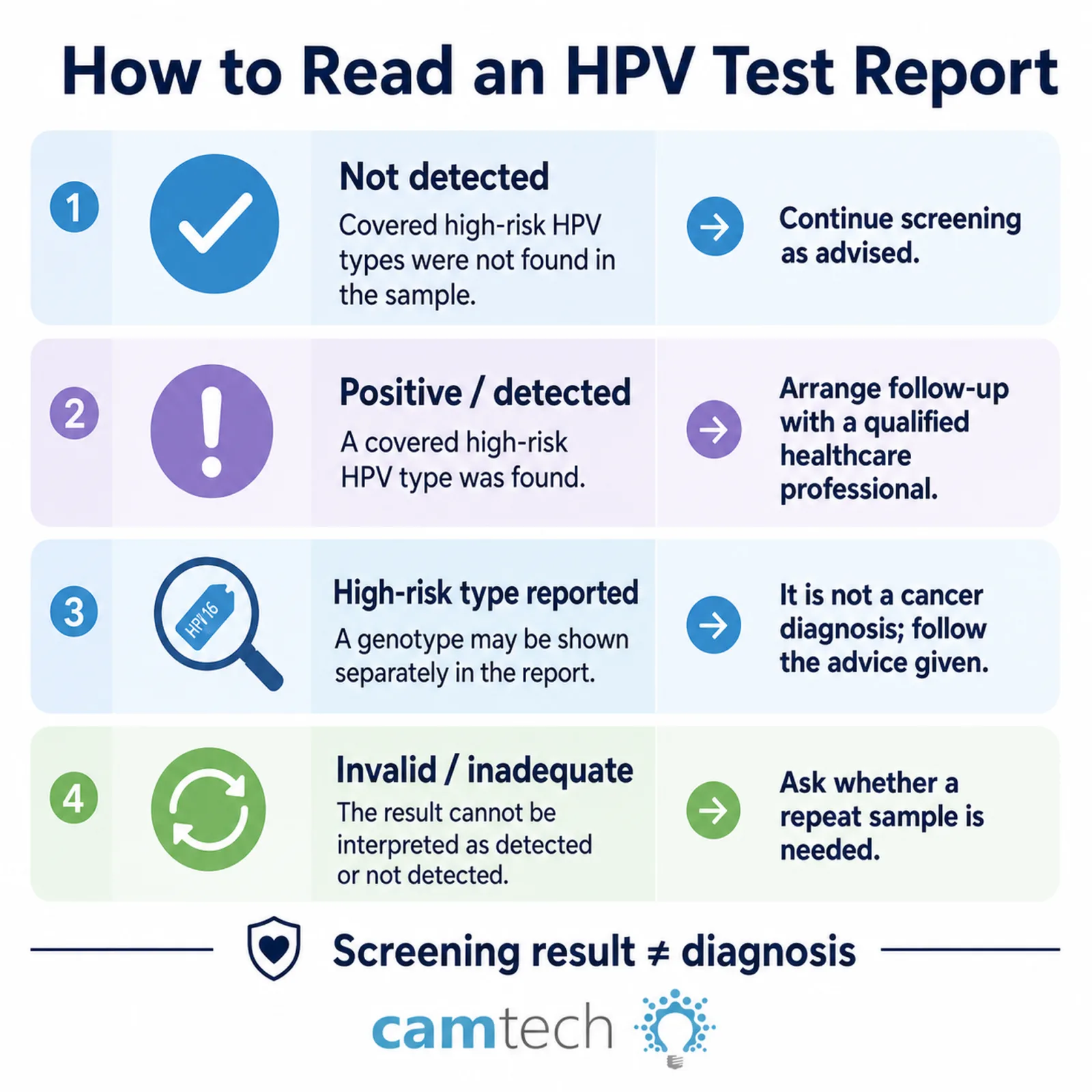
- Not detected / negative: covered high-risk HPV types were not found in the submitted sample. Continue screening as advised, and do not use the result to dismiss symptoms.
- Positive / detected: a covered high-risk HPV type was found. This is not a cancer diagnosis; follow the recommended assessment.
- High-risk type reported: the report may give more detail about a genotype or group. “High-risk” is a screening category, not a diagnosis.
- Invalid / inadequate / inconclusive: the result could not be interpreted reliably. Ask whether a repeat sample or another screening route is needed.
References
- HealthHub Singapore: Learn more about recommended screening tests by age
- National Cancer Institute: HPV and Pap Test Results, Next Steps after an Abnormal Test
- World Health Organization: HPV self-sampling as part of cervical cancer screening
- GOV.UK: Cervical screening laboratory guidance for HPV testing and cytology services
- Camtech Health: HPV Test Singapore, At-Home Cervical Cancer Screening Kit
Medical disclaimer
This article is for general education and is not medical advice. It cannot diagnose HPV, cervical-cell changes, cervical cancer or any other condition, and it cannot replace an examination, cervical screening, laboratory testing or treatment by a qualified healthcare professional. Follow the current Singapore guidance, our Instructions for Use and your clinician’s advice. Seek urgent care for heavy bleeding, severe or rapidly worsening pain, fainting or acute illness. *Visuals are assisted by artificial intelligence (AI)
Frequently asked questions
Does a positive HPV result mean that I have cervical cancer?
No. It means that a covered high-risk HPV type was detected in the submitted sample. Follow-up helps explain what the result means in your circumstances.
What does “not detected” mean on an HPV report?
It means the covered high-risk HPV types in that test panel were not detected in the submitted sample at the time of testing. You should still continue screening as advised and ask about any symptoms.
Is high-risk HPV the same as abnormal cervical cells?
No. High-risk HPV describes certain HPV types. A separate Pap or other cell assessment is needed to check for abnormal cervical cells.
What should I do after an invalid HPV result?
Contact the service or healthcare professional named in the report. Ask whether you need a repeat sample, another screening route or individual advice.
Can I ignore symptoms if my HPV result says not detected?
No. A screening result does not explain every symptom. If you have unusual bleeding, discharge changes, pelvic pain, pain during sex or a new lump or sore, arrange clinical assessment.