What Can a DNA Test Tell You About Your Health?
By Stuart Chan
If you are considering a health DNA test, it is natural to wonder whether the report will give you a clear answer about your future. Deoxyribonucleic acid (DNA) is part of the biological information you inherit from your family, and a DNA test can examine selected genetic variations linked with particular traits or predispositions. The useful question is not whether a test can reveal "everything" about your health, but what this test was designed to examine and what you can reasonably do with the information.
A wellness DNA report can give you a starting point for better questions about daily habits, family history and future conversations with a healthcare professional. It is not a diagnosis or a prediction of your future, and it cannot replace care for symptoms or recommended screening.
What does a health DNA test actually examine?
"DNA test" can describe very different services. Before you compare results or decide what to buy, check what question the test is intended to answer. A clinical genetic test may be ordered because a person has symptoms, a significant family history or a specific medical question. A direct-to-consumer (DTC) test is bought or arranged by an individual and may focus on ancestry, traits, wellness or selected disease-related information.
The test method matters too. Some tests look at a single gene or a small panel of genes. Others examine many genetic markers, or variants, across a defined set of traits. No single test detects every genetic condition. The Centers for Disease Control and Prevention (CDC) guide to genetic testing explains that the right test depends on the medical question, family history and the condition being considered.
That is why your result is meaningful only within its intended scope. A report about selected wellness traits should not be read as if it were a clinical investigation into every possible condition.
What can a wellness DNA test tell you?
Depending on the test, a wellness report may describe genetic tendencies associated with nutrition, fitness response, skin characteristics, ageing or other lifestyle-related traits. You might use it to explore how an insight relates to your usual diet, exercise routine, recovery habits or skin-care choices, but the insight still needs everyday context.
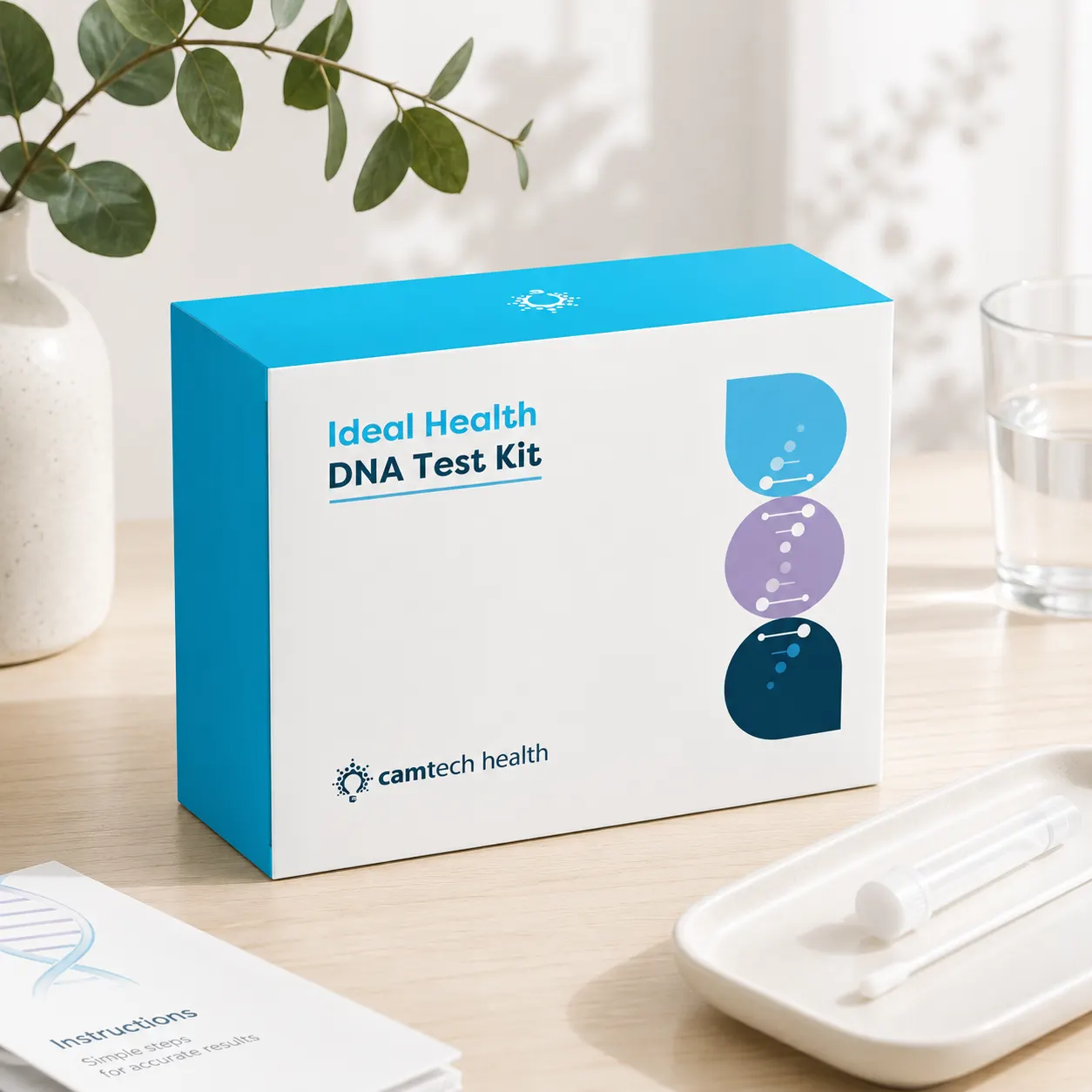
At Camtech Health, our IDEAL Health DNA Test is an at-home saliva test covering 56 traits related to skin, fitness, nutrition and ageing, with ethnicity-based context and a digital health assessment report. These are features of our test, so check our current product information and your report rather than assuming that every DNA test covers the same areas.
The most useful output is often a clearer set of questions:
- Which traits or markers did the test actually assess?
- What does the report mean by "predisposition", "higher likelihood" or "lower likelihood"?
- Is the result based on one marker, several markers or a broader score?
- What evidence supports the recommendation?
- Which everyday factors could strengthen, weaken or outweigh the genetic tendency?
Your genetic tendency is one piece of context. Sleep, nutrition, activity, stress, medication, age, environment and existing health conditions also influence how your body functions. Use your report to support a more thoughtful conversation about those factors, not to replace it.

What a DNA test cannot tell you on its own
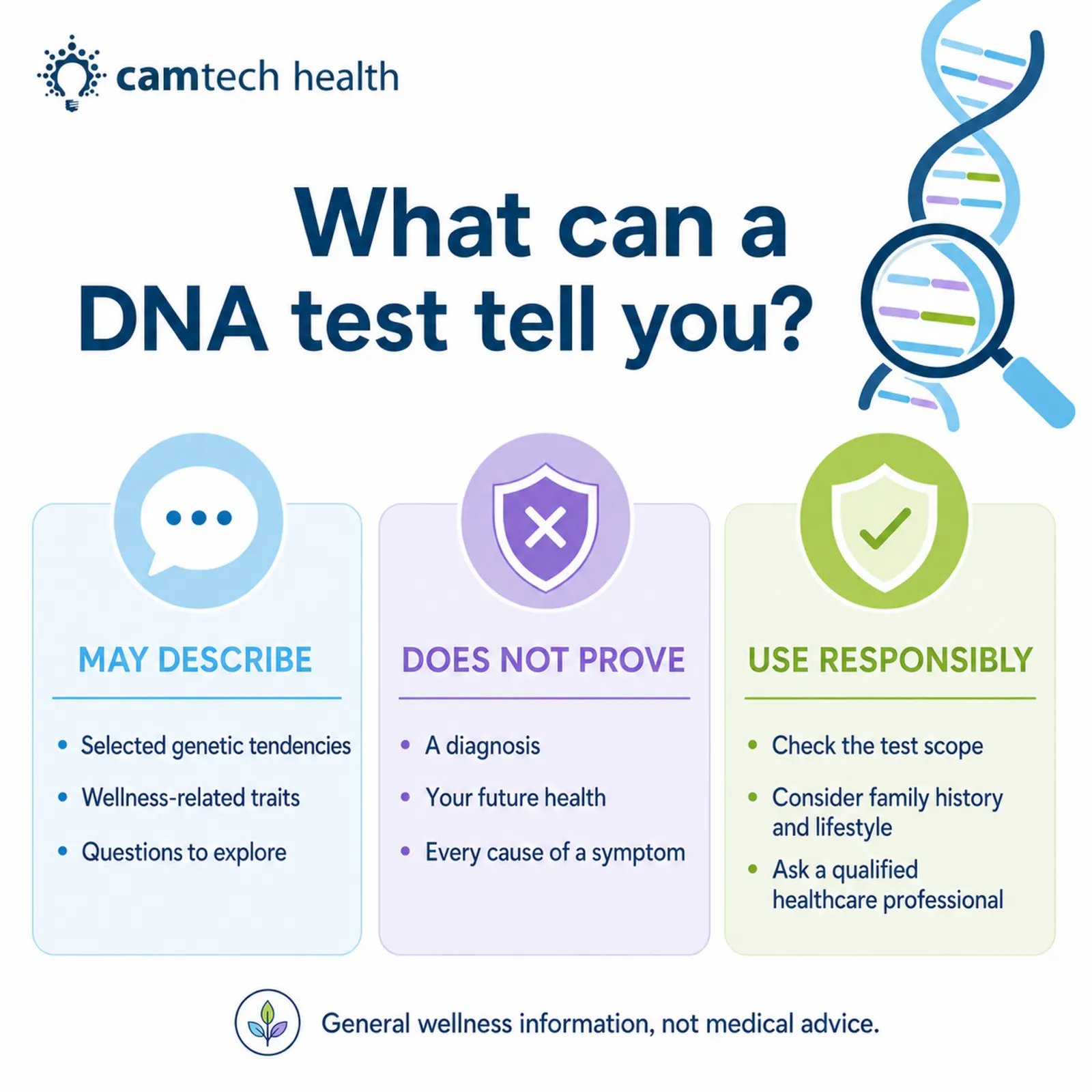
A wellness DNA result cannot tell you with certainty whether you will develop a disease, whether you currently have a condition or how severe a future health problem would be. Even clinical genetic testing can have limits. If you have symptoms or a strong family history, a wellness report is not the right tool to settle a medical question on its own.
The CDC states that DTC results cannot determine for certain whether you will get a disease and should not be used alone for treatment or medical-care decisions. MedlinePlus' overview of genetic testing also notes that genetic testing may provide limited information about symptoms, severity or how a disease may progress.
A result that sounds reassuring does not cancel symptoms, family history or routine screening. A result that sounds worrying does not prove that you have a disease. If you have symptoms, are pregnant, are planning a pregnancy or have a strong family history, ask a qualified healthcare professional whether you need a clinical assessment or a different type of genetic test.
This distinction is especially important for cancer concerns. The CDC's guidance on taking a genetic test on your own explains that a consumer test may not give a complete picture of hereditary cancer risk. A negative result from a limited test does not rule out other genetic or non-genetic risk factors.

How to read the result without over-interpreting it
When you receive your report, start with the test description rather than the most dramatic sentence on the page. Check the sample type, markers or traits included, population or reference group used, and whether the report is for general wellness or clinical decision-making.
Then separate three different ideas:
- A genetic finding: a variation or pattern detected by the test.
- An interpretation: what the provider believes that finding may mean for a particular trait or tendency.
- An action: a sensible next step based on the report, your own circumstances and professional advice.
These three steps are not interchangeable. A genetic association is not automatically a diagnosis. A recommendation to pay attention to a lifestyle area is not a treatment plan. A "lower likelihood" result is not proof that a condition is impossible.
If the report uses technical language, look for its glossary or scoring explanation and write down anything you do not understand. If a medical decision depends on a finding, ask whether it needs confirmation by a clinical laboratory. Before testing, or uploading raw genetic data anywhere, review how the provider uses, stores and shares your sample and genetic information.
At Camtech Health, our article From Data to Action: How to Use Your DNA Results to Improve Your Lifestyle offers a practical reminder: translate genetic information into small, realistic habits and keep the distinction between genetic predisposition and diagnosis clear.

How to use DNA insights responsibly
If you want to use the report constructively, treat it as a prompt for a broader health review:
- Record your context. Note your family history, current symptoms, medicines, activity, sleep and usual eating pattern before deciding what an insight means for you.
- Choose one manageable question. For example, ask whether a nutrition-related insight is relevant to your current diet rather than removing several food groups at once.
- Track one change at a time. If you alter a routine, notice how you feel and whether the change is sustainable; do not treat a short-term response as proof of a genetic effect.
- Discuss medical concerns. Take the report to a doctor, genetic counsellor or other appropriately qualified professional if it raises questions about symptoms, family risk, pregnancy, medication or treatment.
- Protect your data. Read the consent, retention, deletion and research-sharing terms before providing a sample or downloading raw data.
Genetic information can also have implications for biological relatives because family members may share genetic variations. The MedlinePlus guide to genetic testing explains that testing can have emotional, social and privacy considerations as well as possible benefits. Give yourself time to understand the scope of the test before sharing a result with relatives or making a major health decision.
The best DNA test is not necessarily the one with the longest list of traits. It is the one whose purpose, evidence, reporting limits, privacy terms and support match the question you are trying to answer.
References
- IDEAL Health DNA Test product information - Camtech Health.
- Genetic Testing - Centers for Disease Control and Prevention.
- Taking a Genetic Test on Your Own: What You Need to Know - Centers for Disease Control and Prevention.
- Genetic Testing - MedlinePlus, U.S. National Library of Medicine.
- Genetic Testing - MedlinePlus Genetics.
Medical disclaimer
This educational article discusses general genetic-testing concepts and wellness information. It does not provide personalised medical advice or diagnose, prevent, treat or monitor any disease. Product scope, intended use and availability vary by region. Seek qualified professional care for symptoms, urgent concerns or decisions about screening and treatment.
Visuals are assisted by artificial intelligence (AI).
Frequently asked questions
Can a DNA test diagnose a health condition?
A clinical genetic test may support diagnosis when ordered and interpreted for a specific medical question. A general wellness DNA test should not be used to diagnose a condition.
Does a DNA test predict my future health?
No. A result may describe a genetic tendency or likelihood for a defined trait, but it cannot account for every genetic, environmental or lifestyle factor. It is a starting point for questions, not a forecast you must live by.
Is a negative result always reassuring?
Not necessarily. A negative result may mean that the tested marker was not detected; it does not rule out every possible genetic or non-genetic cause of symptoms or risk. If you are concerned, discuss the full picture with a qualified professional.
Should I show my DNA report to a doctor?
If the report raises medical questions, or if you have symptoms or a strong family history, share it with a qualified healthcare professional. They can help you decide whether further assessment is appropriate.
What should I check before buying a DNA test?
Before you buy, check the purpose, traits or markers included, sample and laboratory pathway, evidence, privacy terms, support and the limits of the report.